New Long-Necked Dinosaur Species Discovered in Brazil During Terminal Construction
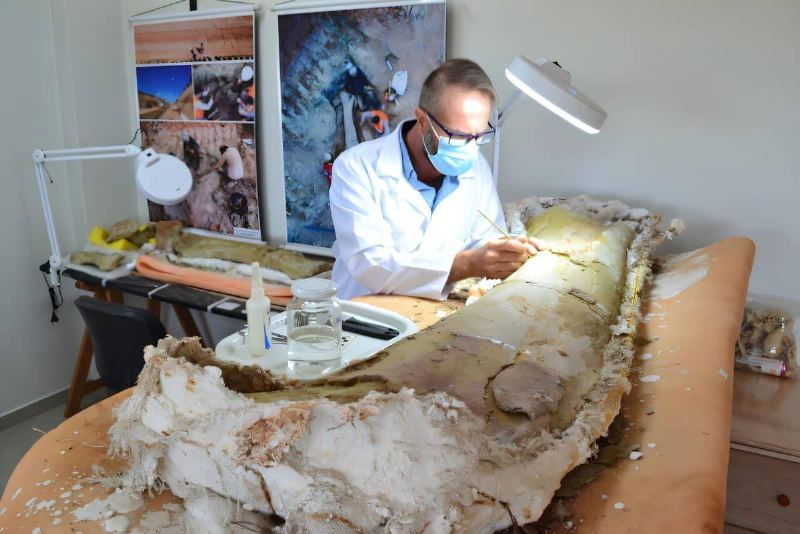
A new species of long-necked herbivorous dinosaur has been discovered in northeastern Brazil, closely related to a European species. This finding suggests that the dinosaur's ancestors migrated from Europe to South America via Africa around 140 million years ago.
While large construction projects often lead to the destruction of historical heritage, the construction of an automobile-rail terminal in Brazil has resulted in the discovery of a new dinosaur species.
The enormous 20-meter long herbivore lived in South America approximately 120 million years ago and has been named Dasosaurus tocantinensis. The name derives from the word daso (“forest”), referring to the wooded area in the state of Maranhão where the fossils were found, and tocantinensis, which refers to the river flowing through that state.
The work has been published in the Journal of Systematic Palaeontology.
Paleontologists concluded that the closest known relative of the new species lived in present-day Spain, suggesting that the South American sauropod had European origins. Its ancestors migrated from Europe through North Africa to South America 140-130 million years ago when these lands were part of the supercontinent Gondwana.
Read this article in full and everything else in Telegram, ad-free
Open in TelegramThanks, I just want to finish reading here
The discovery of the new species strengthens the biogeographical connections between South America, the more northern regions of Gondwana, and the European archipelago. Paleontologists have found tail vertebrae, a femur measuring 1.5 meters, ribs, and bones of the fore and hind limbs. Scientists expect to find more fossils of this dinosaur in the area.
Researchers conducted an analysis of the microstructure of the bones and their growth patterns, revealing that they combine features of two groups of long-necked herbivores — more primitive sauropods and more evolutionarily advanced titanosaurs. This finding suggests that certain growth patterns and bone remodeling occurred earlier than previously thought, helping to explain how some dinosaurs achieved such enormous sizes.
The research team is currently negotiating with the construction company to continue excavations and search for new fossils that may provide further information about this species and the group as a whole.