Incredible Discovery: Norwegian Finds 1500-Year-Old Gold Sword Fitting
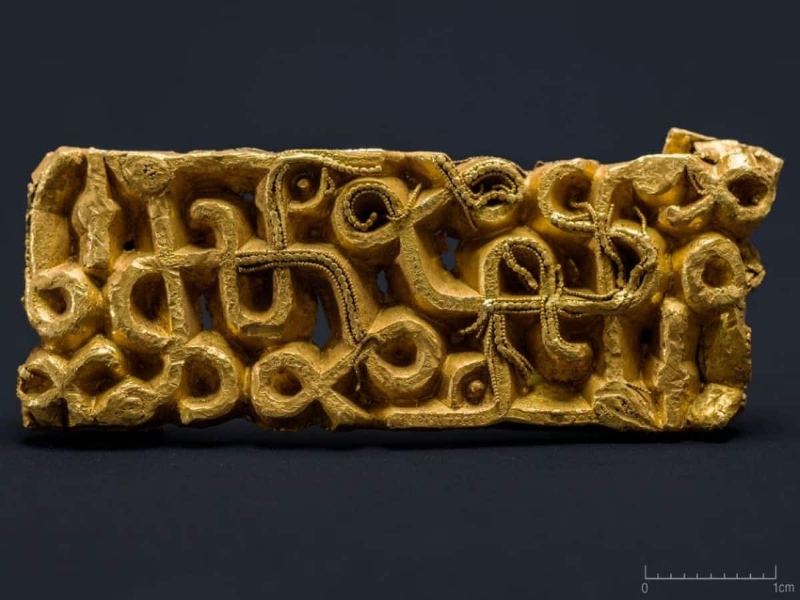
A man in southwestern Norway made a rare discovery during his morning walk — a gold decoration for a sword sheath depicting intertwined serpent-like creatures. Researchers believe that in the 6th century, this artifact was placed in a rock crevice as an offering to the gods during times of famine and social upheaval.
A resident of the municipality of Sannes was hiking near the popular Riaren hill when he noticed a glimmer under the roots of an old tree that had fallen years ago. Unsure of what he had found, he handed the discovery over to the Archaeological Museum of the University of Stavanger. Archaeologists concluded that this 6th-century gold artifact once adorned the sheath of a sword belonging to a military aristocrat.
According to archaeologist Håkon Reyersen, the sword's owner was likely a chieftain in the region during the first half of the 6th century, accompanied by a loyal band of warriors. Gold fittings for sword sheaths typically show little signs of wear, but this one is heavily worn, indicating that the chieftain used it frequently, emphasizing his status and power.
Only 17 similar artifacts have been discovered in Northern Europe, and the chances of finding something like this by chance are minimal. The fitting measures two by six centimeters, weighs 33 grams, and appears at first glance to be a chaotic intertwining of lines, but it actually represents an animalistic ornament common in Norway during the first half of the 6th century.
Read this article in full and everything else in Telegram, ad-free
Open in TelegramThanks, I just want to finish reading here
Researchers note that at the center of the composition are two animal figures facing each other. The patterns can also be interpreted as a human head with an animal body — a mixed motif often found in this design style. The fitting shows traces of intricate detailing, with a fine triple thread of gold beads following the lines of the pattern, creating a shimmering effect.
This artifact belongs to a turbulent period in the region's history. In the 6th century, Southern Norway experienced a significant population decline due to volcanic eruptions, prolonged cold spells, famine, and bubonic plague epidemics. These disasters were accompanied by clan struggles for power and social upheaval.
Researchers suggest that the gold fitting was not accidentally lost; it was intentionally placed in a rock crevice as a sacrifice to the gods during difficult times and to affirm the status and power of its owner. Such practices were common in Scandinavia during that era. Previously, other ancient items found in the Riaren hill area included a silver necklace adorned with gold and a large Roman bronze cauldron produced on the Rhine in 300 AD.