Brazil Maintains Coffee Production Leadership: 2026 Forecast
Brazil is expected to retain its status as the world's largest coffee producer in 2026, further widening the gap from competitors amid rising global demand, despite climate issues and supply instability in key growing regions.
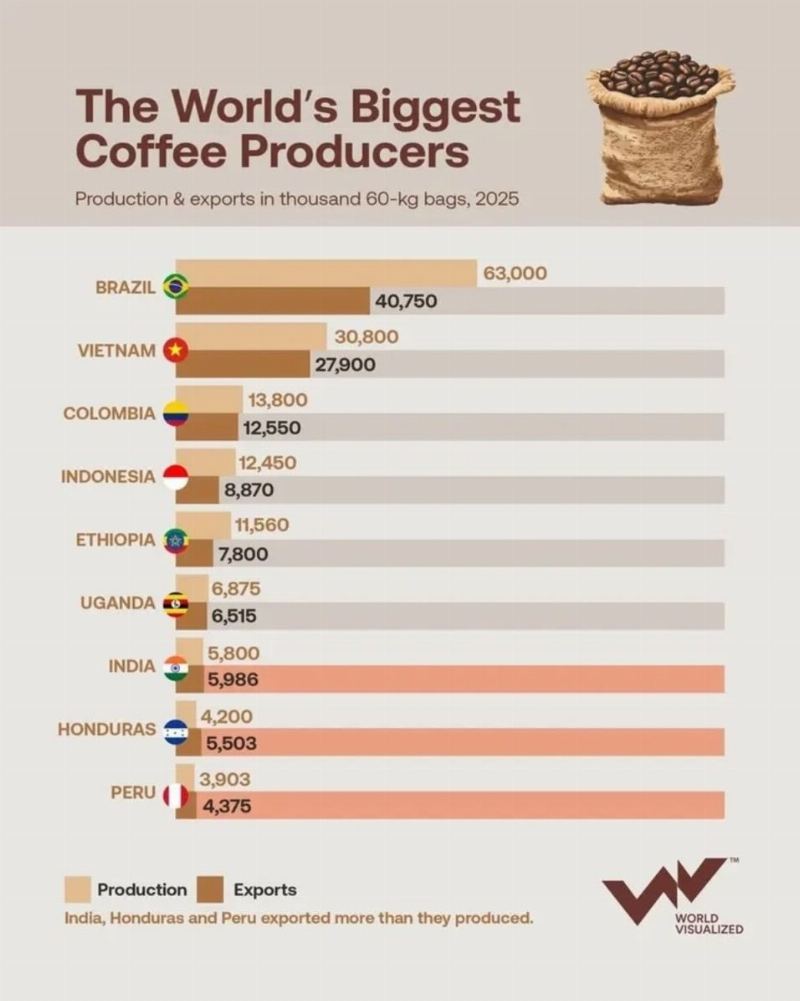
According to data from the USDA's Foreign Agricultural Service and other organizations, Brazil's coffee production in 2025 is projected to reach approximately 63 million 60-kilogram bags, more than double that of Vietnam, which ranks second with 30.8 million bags.
Brazil's exports will also remain the largest in the world, with plans to supply over 40 million bags of coffee to the global market in 2026, reaffirming its role in the global coffee industry.
Today, Brazil accounts for about one-third of the world's coffee production and remains the main supplier of Arabica, widely used in premium blends and espresso.
Vietnam, in second place, expects to export around 27.9 million bags, primarily due to Robusta, which contains more caffeine and is actively used in instant coffee production. With rising Arabica prices, the demand for Robusta continues to grow.
Colombia ranks third with a production of 13.8 million bags, followed by Indonesia and Ethiopia with volumes of 12.45 and 11.56 million bags, respectively.
Read this article in full and everything else in Telegram, ad-free
Open in TelegramThanks, I just want to finish reading here
In Africa, Uganda is strengthening its position, with coffee production expected to approach 6.9 million bags, according to USDA estimates.
Interestingly, countries like India, Honduras, and Peru may export more coffee than they produce, thanks to carryover stocks and re-exports.
The global coffee industry faces increasing pressure from extreme weather events related to climate change. Brazil has experienced severe droughts and frosts from 2021 to 2023, and similar issues have affected Vietnam and Colombia.
The International Coffee Organization has repeatedly warned that climate instability is becoming one of the main long-term threats to global coffee-growing regions, especially for Arabica, which is highly sensitive to temperature changes.
Despite supply risks, global coffee consumption continues to rise steadily. USDA forecasts further demand growth in Asia and developing markets, while Europe and North America remain the largest consumers of coffee worldwide.
Analysts believe that supply shortages and weather issues have contributed to high global coffee prices over the past two years, highlighting the market's dependence on a limited number of producing countries and the serious climate risks involved.