Remarkable Discovery: Neanderthal Knee Print Found in Bruniquel Cave

At the end of the 20th century, ring structures made of hundreds of stalagmites and traces of fire were discovered in a French cave. Recently, researchers found an indentation in the clay that may be a knee print of a Neanderthal. If the hypothesis is confirmed, this will be the first known knee print of a Neanderthal and may help obtain biological traces of the ancient builders of these structures.
In 1990, speleologists found unusual man-made structures in the Bruniquel cave in southwestern France, located 336 meters from the entrance. These structures are circles made of more than 400 stalagmites.
An international team of archaeologists, paleoanthropologists, and geologists led by Sophie Verheyden from the Royal Belgian Institute of Natural Sciences studied the structures and published their findings in the journal Nature in 2016. It is believed that the circles were created by Neanderthals approximately 176,000 years ago, when Homo sapiens were not yet present in Europe.
Neanderthals used stalagmites to create ring structures, with the largest having a diameter of about seven meters. Later, the cave was occupied by cave bears, which may have destroyed many ancient prints.
Read this article in full and everything else in Telegram, ad-free
Open in TelegramThanks, I just want to finish reading here
Verheyden and her team re-examined the cave and found an indentation that does not resemble an animal or human track. This indentation may be a knee print of a Neanderthal. To confirm the hypothesis, comparisons with other prints are necessary.
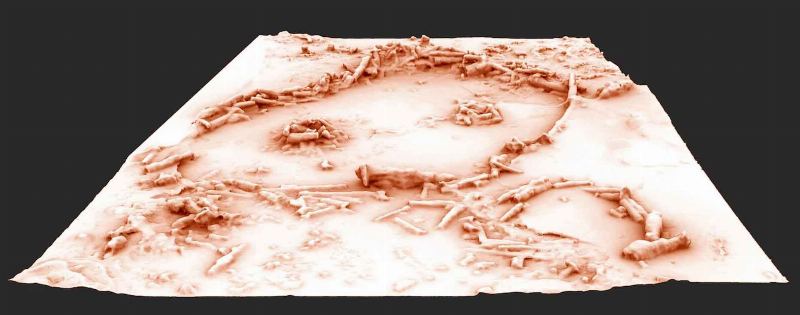
The team also plans to search for Neanderthal DNA, as DNA can be preserved in calcite. Researchers conducted a comprehensive study that confirmed the anthropogenic origin of the structures by dating the bases of broken stalagmites that coincide with the time of construction.
The circles are located more than 300 meters from the entrance, raising questions about how Neanderthals illuminated this dark area. Traces of fire confirm the use of lighting, but researchers doubt that Neanderthals lived here permanently.
Some scientists suggest a ritual purpose for the structures, but Verheyden believes such conclusions are premature. The team is developing a method of "mineral fingerprinting" to determine where Neanderthals sourced the material for building the circles.
The results of the work were presented at the European Geosciences Union conference held in Vienna.