Gravitational Waves Unveil Secrets of Black Holes and Nuclear Fusion
Astronomers have for the first time used gravitational waves to indirectly assess key processes of nuclear fusion in massive stars. These processes determine which stars explode, which become black holes, and how carbon and oxygen — elements essential for life — are formed in the universe.
The existence of a "mass gap" for black holes (BH) has long been suspected by scientists. According to theory, stars of certain masses should not directly collapse into BHs due to a rare type of explosion known as pair-instability supernovae. In the cores of very massive stars, gamma radiation begins to produce electron-positron pairs, leading to a drop in pressure, causing the star to either partially lose mass or completely disintegrate.
This creates a "forbidden zone" for black holes with masses between approximately 40 and 130 solar masses. However, detectors LIGO, Virgo, and KAGRA have been recording mergers of objects that seem to fall within this range. Astrophysicists debated whether the theory is incomplete or if such black holes form in unusual ways, such as through repeated mergers in dense star clusters.
The authors of a new study published in the journal Nature Astronomy analyzed the largest catalog of gravitational-wave events, GWTC-4, which includes 153 mergers of black holes. The study examined not only the masses of the objects but also their rotation. It was found that most black holes with masses less than 45 solar masses rotate relatively slowly and are uniformly oriented — typical behavior for objects formed from stellar collapse. However, above this threshold, the picture changes significantly: black holes begin to rotate faster, and their rotation directions become chaotic.
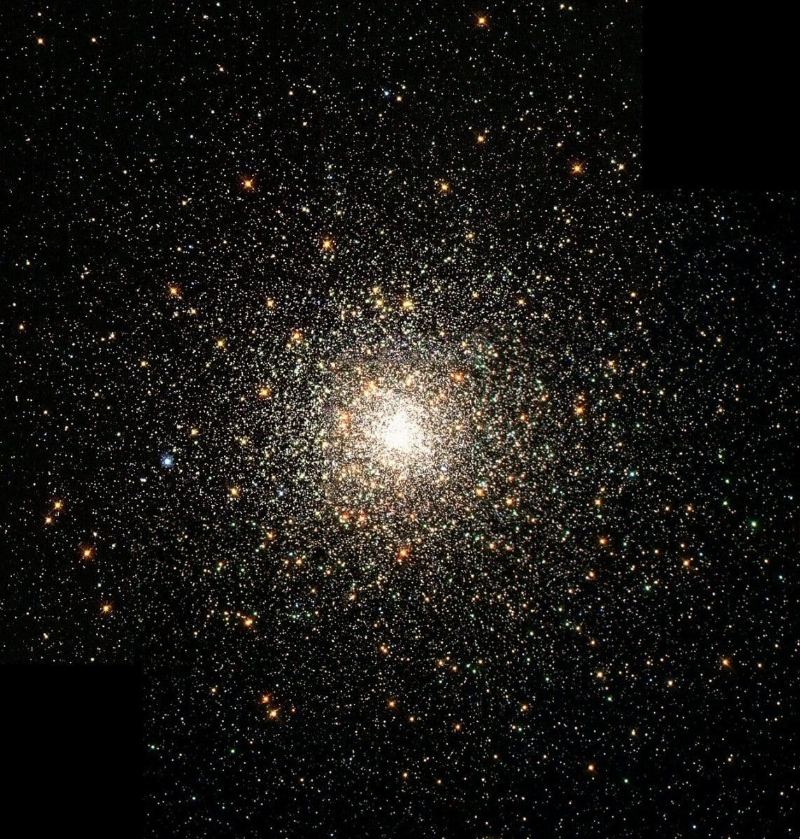
This behavior aligns well with the scenario of "hierarchical mergers," where black holes in dense globular clusters can repeatedly collide and merge. As a result, objects capable of "filling" the predicted mass gap are formed. Repeated mergers naturally create rapidly rotating black holes with chaotic axis orientations — exactly what astronomers observed.
Read this article in full and everything else in Telegram, ad-free
Open in TelegramThanks, I just want to finish reading here
The lower boundary of the forbidden zone has been estimated at about 44 solar masses. Surprisingly, this boundary also allowed for the calculation of the rate of the nuclear reaction in which carbon in a star's core is converted into oxygen. This reaction is one of the main uncertainties in astrophysics, as measuring it in the laboratory is extremely difficult due to the conditions inside stars being impossible to fully replicate on Earth. Now, the universe has served as a giant laboratory.
Researchers also derived the value of the so-called S-factor — a parameter describing the probability of the reaction between carbon and helium. This affects the chemical composition of the star's core before the explosion: the faster carbon is converted into oxygen, the earlier pair instability arises, making it easier for the star to disintegrate instead of forming a black hole. Essentially, gravitational waves have allowed for the indirect measurement of processes occurring in the hot cores of stars millions of years before their demise.
This discovery connects several fields of science — gravitational-wave astronomy, black hole physics, stellar evolution, and nuclear physics. Such measurements may help understand how chemical elements formed in galaxies and why some stars become neutron stars while others become black holes.
The accuracy of these estimates will improve with each new catalog of gravitational waves, allowing astronomers to delve deeper into processes that were previously accessible only through theoretical models.