Neanderthal Infants Developed Faster Than Homo sapiens, Study Finds

Neanderthal infants outpaced Homo sapiens in physical development speed, according to a study. Researchers examined nearly complete skeletons of a Neanderthal child found in Israel.
The infant, known as Amud 7, was discovered in 1992 in the Amud cave. It lived in what is now Israel around 51,000 to 56,000 years ago, and its sex could not be determined.
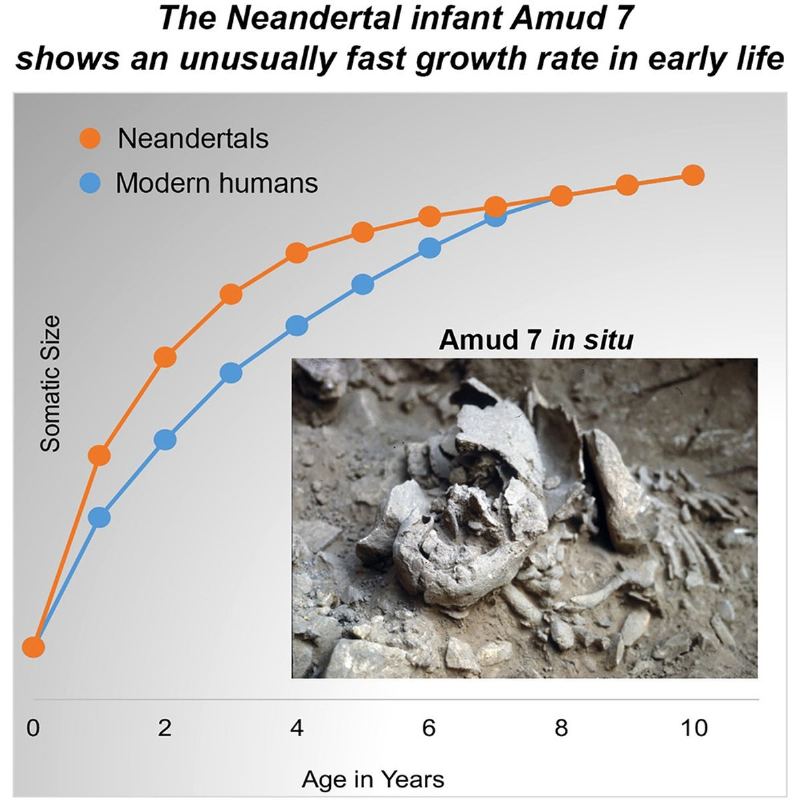
A detailed anatomical analysis of Amud 7's bones and teeth revealed that the child was about 6 months old at the time of death. However, the length of the bones and the level of brain development corresponded to that of a modern child aged 12-14 months. This suggests that Neanderthal children grew faster and reached physical development milestones earlier than Homo sapiens children.
It is unknown how advanced Neanderthal infants were in behavioral terms, and when they began to walk. However, they were large, but not necessarily chubby.
The data obtained from the analysis of the Amud 7 skeleton is supported by studies of Neanderthal children's remains found in Syria and France. Neanderthal children appear to have had a unique developmental pace.
Read this article in full and everything else in Telegram, ad-free
Open in TelegramThanks, I just want to finish reading here

Researchers identify three stages of growth for Neanderthal children. In newborns, tooth development typically matches the development of the rest of the body. Then, in infants like Amud 7, there is a growth spurt in body and brain, while teeth develop more slowly. In older children, tooth and body development syncs again, while the brain continues to grow rapidly.
The accelerated growth may have been linked to the conditions in which Neanderthals lived. A larger body helps retain heat, suggesting that rapid growth in early age could have been an adaptation to the cold climate of Ice Age Eurasia.
By the age of seven, differences between Neanderthal and Homo sapiens children appeared to level out, and their development proceeded in a more similar manner.