James Webb Space Telescope First to Study Surface of Exoplanet LHS 3844 b

The studied exoplanet is located 50 light-years away from us.
The James Webb Space Telescope has allowed astronomers to study the surface of the exoplanet LHS 3844 b for the first time, situated 50 light-years from Earth.
LHS 3844 b is a rocky "super-Earth" approximately 30% larger than Earth. It orbits a cold red dwarf star in just 11 hours and is tidally locked, meaning one side of the planet always faces the star while the other remains in darkness.
The temperature on the day side of LHS 3844 b reaches about 725 degrees Celsius, enabling the telescope to gather data on the surface composition due to strong infrared radiation.
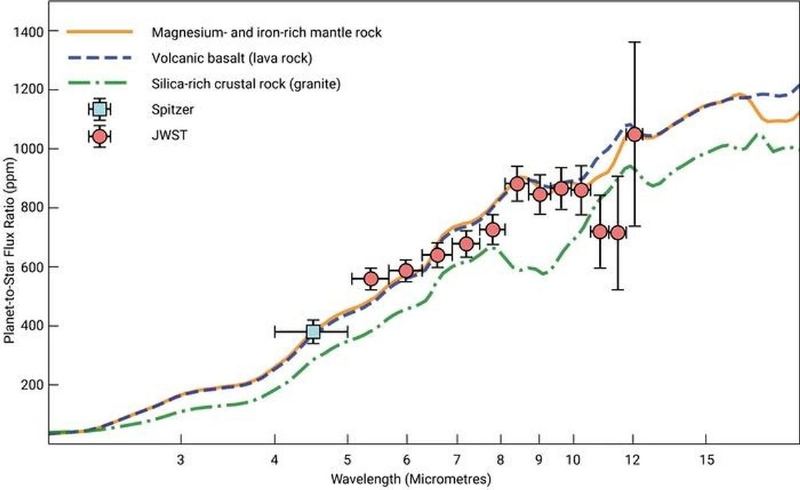
Analysis indicates that the planet is largely devoid of atmosphere and represents a lifeless rocky world, likely composed mainly of basalt.
Read this article in full and everything else in Telegram, ad-free
Open in TelegramThanks, I just want to finish reading here
Scientists reached this conclusion by comparing the spectrum of the exoplanet with the characteristics of rocks and minerals known from Earth, the Moon, and Mars. It is suggested that there is virtually no water on LHS 3844 b.
According to one theory, the surface of LHS 3844 b is relatively young and may have been formed by recent volcanic activity. However, there is a possibility that the exoplanet is covered by a thick layer of dark fine-grained material formed under the influence of stellar radiation and meteorite impacts.
A final conclusion about the surface composition of LHS 3844 b will be made after further observations.