Greek Visa on Arrival: New Opportunities for Turkish Tourists
The visa-on-arrival scheme for Turkish travelers to 12 Greek islands has significantly simplified access to this corner of the EU, which was previously virtually closed without a hard-to-obtain Schengen visa.
Launched in April 2024, the program, known in Turkey as the "border visa" (kapi vizesi), initially covered 10 Greek islands and was extended to 12 last year.
The list of islands in the Aegean Sea, all near the Turkish coast, includes Chios, Kalymnos, Kastellorizo, Kos, Leros, Lesbos, Limnos, Patmos, Rhodes, Samos, Samothrace, and Symi.
It allows Turkish citizens to visit participating islands for up to seven days without prior application for a full Schengen visa, but it cannot be extended and does not grant the right to travel to mainland Greece or other Schengen countries.
“Getting a Schengen visa is becoming increasingly difficult for Turks, but this new system makes traveling to the Greek islands easy and quick for us,” said 21-year-old student Emirhan Gürses from Manisa.
According to the Bank of Greece, nearly 1.5 million Turks visited the country in 2025, compared to 1.2 million in 2024. Turkish tour operators say most of them used the express visa to see the islands.
For many Turks, this scheme offered an affordable alternative at a time when rising inflation is making vacations at home increasingly expensive.
During a visit to Ankara in February, Greek Prime Minister Kyriakos Mitsotakis called the program “particularly successful.”
“In just the past year, hundreds of thousands of our Turkish friends have traveled to the Greek islands, bringing our peoples closer together,” Mitsotakis said, adding that both countries want to extend the program.
Read this article in full and everything else in Telegram, ad-free
Open in TelegramThanks, I just want to finish reading here
“An Ideal Place to Start”
For Ikra Altyumsek, like many other Turkish tourists, the program has provided an opportunity to visit some of Greece's most popular island destinations.
“I think Samos was the perfect place to start,” said 21-year-old student, rolling her suitcase alongside her mother as they waited for the ferry from the Greek island of Samos.
They were returning to Kuşadası on the Aegean coast of Turkey after a sun-soaked vacation — this was Altyumsek's first trip abroad.
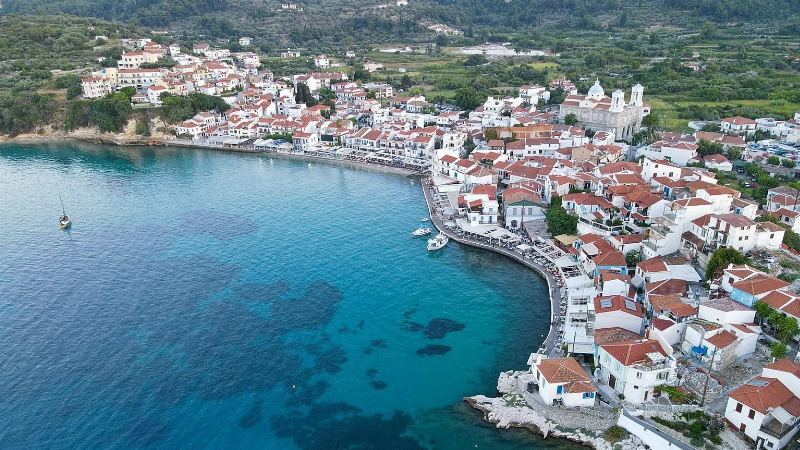
With its turquoise waters, quiet bays, traditional villages, and seaside restaurants, Samos, located directly across from the Turkish coast, combines beaches and natural beauty with a rich cultural heritage, including ancient monuments associated with Pythagoras — one of the most famous figures of the ancient Greek world.
Turkish vessels under the national flag with tourists on board constantly cruise along the waterfront, coming and going throughout the day — a visible testament to the steady flow of Turkish guests to the Greek island.
“The food here is very delicious. I have a 17-year-old son, and he keeps asking, ‘Mom, when are we going to Greece to eat?’” said 51-year-old Nevin Çalıgüney.
The crowds arriving in Samos reflect the diversity of Turkish society, which is not in the EU but aspires to join it someday.
Among the arrivals are young travelers discovering the island for the first time, as well as families, including women in headscarves accompanied by husbands and children in strollers.
Many restaurants display menus in Turkish at their entrances.
“A Significant Impact” on the Economy
The visa-on-arrival program emerged against the backdrop of growing Turkish demand for travel to the EU, which in many consulates exceeds their capacity to process Schengen visa applications, leaving applicants facing long waits, rising costs, and uncertainty over approval.
According to guide Mikail Esabalioglu, a Greek living on Samos and originally from Istanbul, Turkish guests are becoming an increasingly important part of the island's tourism economy.
“We receive many Turkish guests, especially from Izmir and other parts of the Aegean coast of Turkey,” he says.
But the program, he says, could be improved further, “because sometimes visitors have to wait a long time at the entrance, and the arrival process can be complicated.”
Business owner on Samos, Yiannis Kagiass, says that Turkish guests have “significantly changed the situation” for the island's economy.
“Our Turkish friends who come here provide us with great support,” he says. “Without Turkish tourists, I think the situation for business on the island would be much more difficult.”
38-year-old consultant from Mersin, Selim Zuberi, believes that the program is also important for bringing the residents of the two neighboring countries closer together.
People can “learn about each other's cultures,” he says. “There have been conflicts in history, but we should not carry these burdens forever. We must enjoy life.”