How Much Work is Needed to Buy a Scoop of Ice Cream?
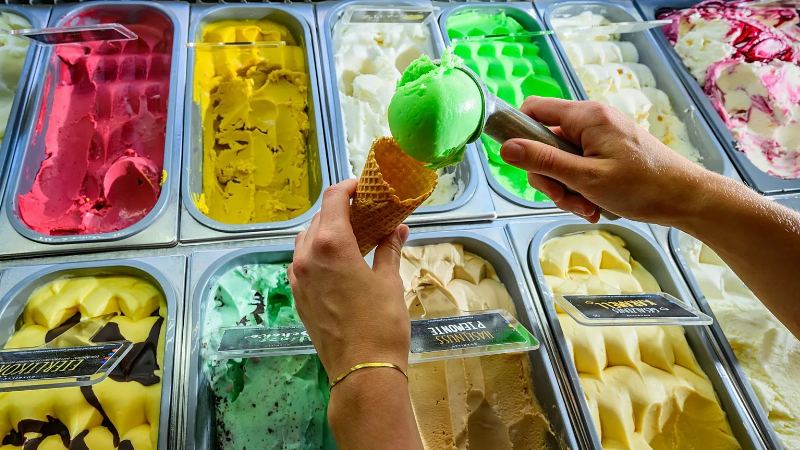
According to data collected by Euronews, the highest price point was found in the UK, while the lowest was in Turkey.
In ten surveyed countries, the estimated price of a scoop of ice cream ranged from approximately €1.15 to €4.10.
Prices varied significantly depending on the location of the sales point, type of establishment, portion size, and flavor. Currency fluctuations also affect comparisons.
Based on information from Euronews, the highest comparable price was recorded in the UK, and the lowest in Turkey.
The data is indicative and not official national price statistics.
Tourist Prices Can Leave a Bitter Taste
While the comparison mainly concerns regular shops and cafes, some tourist prices are hard to ignore.
In mainland Greece, the price of a scoop is around €2.60, while on popular tourist islands it can reach €4–6.
In Turkish tourist areas, prices have also surged: a serving can cost 100–120 Turkish lira, approximately €1.85–2.20. This is a significant markup compared to the average price of 62.50 lira in regular establishments in Istanbul.
In the UK, the data is less directly comparable. Buying individual scoops in specialized ice cream cafes does not reflect British habits, as most prefer soft serve in cones or packaged products from ice cream vans.
According to a recent survey commissioned by Aldi and conducted by OnePoll among 2,000 parents in the UK, respondents pay an average of £2.65 (approximately €3.10) for ice cream purchased from a van.
How Much Work Time Goes into One Ice Cream?
The cheapest scoop in euro terms does not always mean the least burden on local buyers.
Read this article in full and everything else in Telegram, ad-free
Open in TelegramThanks, I just want to finish reading here
To assess how much work is needed to afford one scoop, Euronews Business compared comparable prices with income and working time data.
For EU countries, annual net income data is sourced from Eurostat. The figure reflects the estimated net earnings of a single worker without children earning at the 100% average wage level.
This calculation is purely illustrative: it does not account for individual tax conditions, differences in work schedules, salary levels, and paid vacations.
So, how much of a workday does one scoop consume?
In Germany, it takes about 7.4 minutes of net working time.
In the UK, the figure rises to 9.3 minutes, and in Belgium to 11.4 minutes. In Italy, the calculated time is 13.2 minutes, and in France, it is 14.5 minutes.
Turkey, Poland, and Spain form a tight group with results around 15 minutes. In Portugal, the value increases to 16.6 minutes, and in Greece, it reaches 20.9 minutes.
This means that under the given assumptions, a worker in Greece needs to work nearly three times longer than a worker in Germany to afford a comparable scoop.
Ice Cream Inflation Begins to Melt
Over the past few years, ice cream prices in Greece have noticeably increased.
Glykos told the Greek publication Ta Nea that since 2020, prices have risen by about 20% mainly due to the cumulative effect of rising energy costs. He noted that energy remains the main issue for the industry, while oil prices play a lesser role.
However, in a subsequent interview with ERT News Radio 105.8, Glykos noted that in 2026, production costs no longer increased and that the main price hikes occurred in 2025.
The cost of ingredients also varies by flavor. According to Glykos, quality pistachios can cost between €40 and €80 per kilogram, while standard flavors like vanilla or strawberry have not seen significant price increases. Rent and location also affect the final price.
Official recent inflation data also indicate that price pressures have eased recently, although significant differences remain between countries.
The harmonized Eurostat index for ice cream and sorbets for the year ending June 2026 decreased by 0.4% across the EU. In the eurozone, the decline was 0.2%.
The largest decrease was recorded in Portugal, where the index fell by 8.3%. This was followed by Sweden with a drop of 4.6% and Denmark and Luxembourg, where the decline reached 2.8%. In Greece, prices decreased by 2.6%, and in Belgium by 2.3%.
On the opposite end are countries where prices have risen: in Lithuania, the increase was 7.9%, in Romania 6.4%, in Slovakia 3.8%, and in Austria 2.6%. Among the countries included in the price comparison, inflation in this category reached 1.2% in Spain, 0.8% in Germany, and 0.2% in Poland. The index decreased in France, Belgium, Greece, and Portugal.
A negative annual inflation figure does not mean that ice cream prices have returned to pre-2020 levels. It simply means that the corresponding price index in June 2026 was lower than a year earlier.