Urbanization Trends: How the World is Changing by 2050
Over the last century, humanity has rapidly urbanized, transforming where people live, work, and build communities.
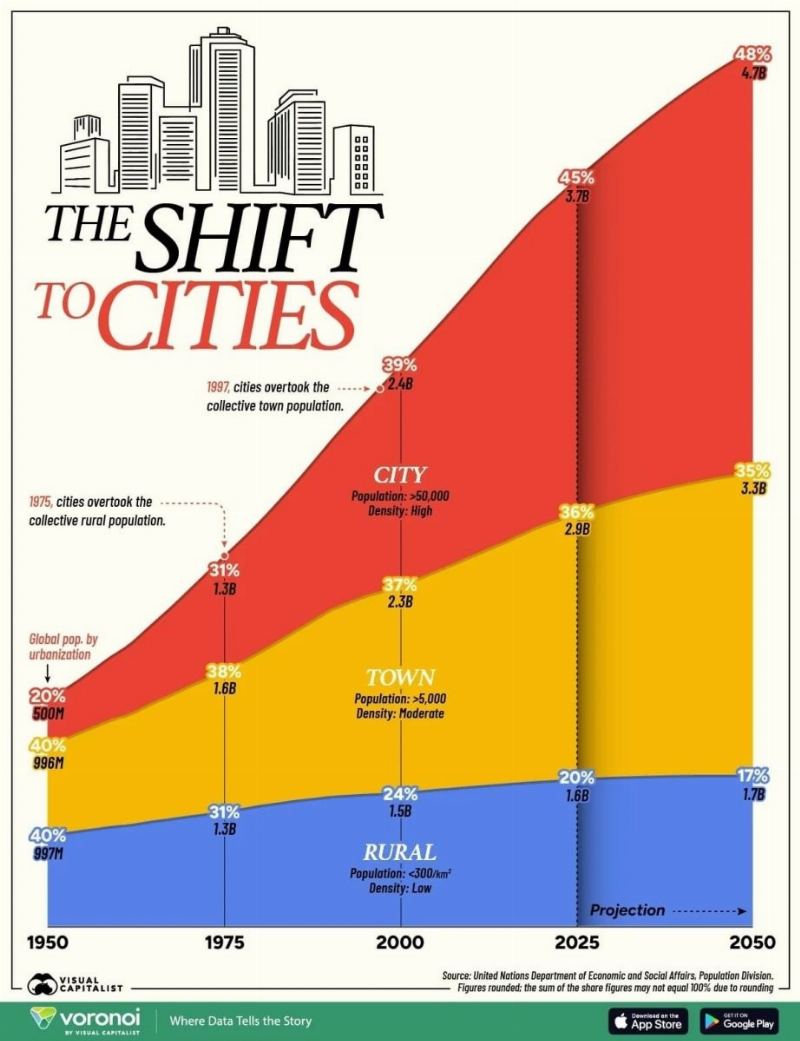
This infographic illustrates how the world's population has changed based on the type of settlement—cities, towns, and rural areas—from 1950 to 2050. The data is prepared by the Population Division of the UN Department of Economic and Social Affairs.
Cities are defined as settlements with at least 50,000 inhabitants. Towns are settlements with populations of at least 5,000. Rural areas are defined as regions with a population density of less than 300 people per square kilometer. The data for 2025–2050 is projected.
In 1950, only 500 million people lived in cities, accounting for about 20% of the world's population. At that time, rural areas and small towns were much more common, with nearly one billion people living in each.
However, this balance began to shift rapidly.
By 1975, the urban population surpassed the rural for the first time: 1.27 billion in cities compared to 1.25 billion in rural areas.
The next significant milestone was reached in 1997 when cities surpassed small towns in population. Since then, cities have remained the largest category of settlements, growing faster than others.
Read this article in full and everything else in Telegram, ad-free
Open in TelegramThanks, I just want to finish reading here
It is estimated that by 2025, 3.69 billion people will live in cities, or about 45% of the global population. Today, cities are the predominant type of settlement in 104 countries.
Although rural population growth lags behind urbanization, it is still increasing in absolute numbers. In 1950, 997 million people lived in rural areas, and by 2025 this figure is expected to reach approximately 1.61 billion.
However, the share of rural residents in the global population is steadily declining:
- 1950: about 40% of the world's population;
- 2025: approximately 20%;
- 2050 (projected): around 17%.
The only major region where rural population has significantly increased over the past 75 years is Sub-Saharan Africa. In all other regions, the main growth has been in cities and towns.
According to UN projections, the global rural population will peak at around 1.65 billion in 2046, after which it will begin to decline in absolute terms, despite the continued growth of the total world population.
By 2050, the urban population is expected to rise to 4.67 billion, more than nine times the figure in 1950. This scale of urbanization is attributed to several factors: mechanization of agriculture, reducing the need for agricultural workers; broader employment opportunities; access to education; better access to goods and services; developed infrastructure; and a more diverse cultural and entertainment environment. It is expected that about two-thirds of the total population growth until 2050 will occur in cities, with most of the remaining growth in small towns.
By mid-century, cities will become the predominant type of settlement in 127 countries. More than 80% of the population will live in cities and towns.
According to UN projections, by 2050 the population will be:
- cities: 4.67 billion;
- towns: 3.34 billion;
- rural areas: 1.65 billion.
Thus, cities and towns will encompass over 80% of the world's population, marking one of the largest demographic transformations in modern history.