Italy Tightens Border Control with Spain Amid Migration Crisis
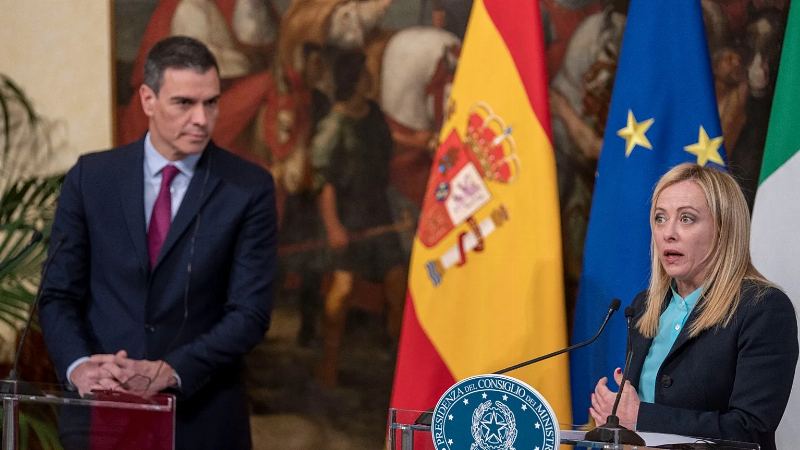
The migration crisis in Ceuta has sparked a political conflict between Italy and Spain. Following reports of thousands of migrants arriving in the Spanish enclave, Prime Minister Giorgia Meloni announced enhanced border control for arrivals from Spain by sea and air.
What Does the Suspension of Schengen Mean?
On Friday, several media outlets reported that Rome is suspending the Schengen Agreement concerning Spain. In her statement on X, Meloni wrote that the government decided to temporarily suspend the free movement regime established by Schengen for maritime and air traffic with Spain, reintroducing border control.
However, the Schengen Agreement already allows for the restoration of control “in case of serious threats to public order or internal security” — a mechanism Italy has been applying at its border with Slovenia for over a year regarding third-country nationals. Interior Minister Matteo Piantedosi called this measure “important but preventive.”
Thus, Italy has reintroduced border control at its border with Spain as an exception to Schengen rules, as no country can unilaterally exclude another from the free movement zone.
Read this article in full and everything else in Telegram, ad-free
Open in TelegramThanks, I just want to finish reading here
How Are Checks for Arrivals from Spain Conducted?
Later, Minister Piantedosi clarified that the restoration of control at maritime and air borders with Spain will last for one month and is aimed primarily at verifying the legality of the stay of non-EU nationals in the Schengen area.
Starting Saturday morning, police conducted random checks at Rome's Fiumicino and Milan's Malpensa and Linate airports. EU citizens only needed to present their ID, while non-EU nationals had to show not only their ID but also valid residence permits or visas.
For citizens departing from Italy to Spain, nothing changes: they can still enter the country freely.
Italy and Spain's Standoff Reaches EU Level
Rome's decision to restore checks provoked a strong reaction from Spanish authorities. Prime Minister Pedro Sánchez sent a letter to the President of the European Council, Charles Michel, and the President of the European Commission, Ursula von der Leyen, requesting Brussels' intervention to support Spain and realign EU strategies to address the migration crisis.
Simultaneously, Italian Prime Minister Giorgia Meloni and Danish Prime Minister Mette Frederiksen sent a letter to European authorities, signed by leaders of 22 other member states, requesting a meeting to discuss urgent measures against illegal immigration.
On Saturday afternoon, von der Leyen stated on social media that she had held talks with Commissioners Brunner and Schuetz regarding the crisis in Ceuta, noting that most migrants who arrived illegally in the enclave have already been sent back home.
The European Commission President added that none of the migrants arriving from Morocco reached mainland Spain or other EU countries, reiterating the need to strengthen Europe's resilience and expressing readiness to participate in a video conference requested by European leaders. This is scheduled for next Tuesday and will be organized by the Irish Prime Minister Micheál Martin, who is currently holding the EU Council presidency.
In their letter, Meloni and Frederiksen called for joint actions to strengthen external borders, combat illegal immigration, enhance deportation efficiency, and eliminate any factors that may encourage new illegal entries.