The Deepest Subway Stations in the World

Most subway stations are located just a few floors below street level. However, some stations go so deep underground that the journey to the platform can take up to eight minutes, and passengers may experience ear pressure similar to that during an airplane landing.
The reasons for such depth lie in geography and history: high riverbanks, hilly city terrains, and the construction of subways during the Cold War, when stations were designed as shelters capable of withstanding bombings, forced engineers to dig tunnels much deeper than usual.
As a result, stations resembling underground palaces or cathedrals adorned with mosaics and served by some of the longest escalators in the world have emerged. Below is a list of the ten deepest subway stations on the planet, starting from the tenth place and ending with the absolute record-holder located more than a hundred meters underground.
10. “Lenin Square” — 67 meters
The “Lenin Square” station on the Kirov-Vyborg line of the St. Petersburg Metro opens the ranking with a depth of 67 meters. It was put into operation in June 1958, and its above-ground vestibule is integrated into the building of the Finland Station — it was here that Vladimir Lenin arrived in 1917 after his emigration. This event is immortalized in a mosaic panel in the central hall of the station.
Architect A. K. Andreyev designed the deep-laid pylon-type station, decorating it in a restrained red-and-white palette, which marked a departure from the opulent Stalinist architecture. After the lighting modernization in 2006, the interior became significantly brighter.
9. Washington Park — 79 meters
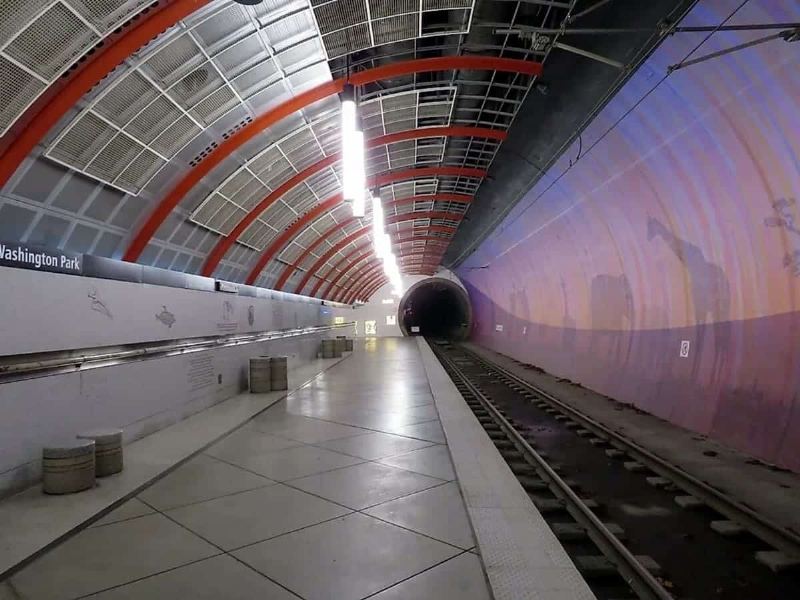
The Washington Park station in Portland, USA, is located at a depth of 79 meters and is considered the deepest public transport station in North America. It is the only fully underground station of the MAX Light Rail system.
It opened in September 1998 along with the western extension of the line. The tunnel was dug deep under the West Hills between the city center and the Oregon Zoo. Thanks to the surrounding rocks, the temperature on the platform remains around +10°C almost year-round. The station walls are decorated with samples of rocks that tell the 16-million-year geological history of the region. Passengers are transported to the surface by high-speed elevators — there are no escalators here.
8. “Victory Park” — 84 meters
The Moscow station “Victory Park” is the deepest in the Moscow Metro. Moreover, it is here that the longest escalators in Europe are located.
Each of them is 126 meters long and consists of 740 steps. The ride takes about three minutes, and the lower platform is so far from the upper one that it cannot be seen.
Read this article in full and everything else in Telegram, ad-free
Open in TelegramThanks, I just want to finish reading here
The construction of the station began back in 1986, but it only opened in 2003. Here, the Arbatsko-Pokrovskaya and Solntsevskaya lines intersect. Architects Natalia Shurygina and Nikolai Shumakov designed the symmetrically mirrored platforms in red and gray tones. An original technology of concrete-filled steel blocks was used in construction, which helped reduce costs.
7. “Admiralty” — 86 meters
The deepest station of the St. Petersburg Metro was built over several decades.
The need to open a station near the Hermitage and the Admiralty was evident, but the historical development of the city center complicated the construction of an exit to the surface. As a result, “Admiralty” opened only in December 2011, although the tunnels around it were ready much earlier.
To a depth of 86 meters, passengers are delivered by one of the longest escalators in the world — first to an intermediate level, then down another escalator even lower. For many years, trains passed through the already built but closed station without stopping, so locals called it the “ghost station.”
6. “University” — 87 meters
The “University” station on the Svyatoshynsko-Brovarskaya line of the Kyiv Metro opened in November 1960 near the Taras Shevchenko National University of Kyiv.
Its pylon three-vaulted hall with columns of red marble and white marble busts of prominent figures is executed in the best traditions of Stalinist Empire style. After the start of the Special Military Operation in 2022, the busts of Russian historical figures were closed. Today, the station, which is a monument of architecture, serves another function — it acts as a bomb shelter, like many other deep stations of the Kyiv Metro.
5. Hongtudi — 94.47 meters
Before the opening of Hongyancun, Hongtudi was considered the deepest station in China.
It is located in the Jiangbei District of Chongqing and connects lines 6 and 10 of the Chongqing Rail Transit system. The station became deeper as construction progressed: the platforms of line 6, opened in 2012, were located more than 60 meters deep, and the launch of line 10 in 2017 increased the maximum depth to 94.47 meters.
To move between the numerous levels, more than 90 escalators are used, making the station a true internet attraction.
4. “Golden Gates” — 96.5 meters
The Kyiv station “Golden Gates,” named after the Golden Gates located above it, opened on December 31, 1989, and regularly ranks among the most beautiful subway stations in Europe.
Architects Boris and Vadim Zhezheriny, together with Nikolai Zharikov, abandoned the original utilitarian project and created an interior reminiscent of a temple from the times of Kievan Rus. The station is adorned with 80 mosaics depicting princes and saints.
At a depth of 96.5 meters, it connects with the “Theatrical” station.
3. “Arsenal” — 105.5 meters
For many decades, “Arsenal” was considered the deepest subway station in the world. Today, with a depth of 105.5 meters, it remains the deepest standalone station outside of China.
Opened in 1960 near the Arsenal factory, the station features an extraordinarily modest design. During construction, engineers faced complex geological conditions and groundwater, which forced them to abandon the central hall. As a result, the station received a layout reminiscent of the London Underground, where pylons serve exclusively decorative purposes.
2. Pyongyang Metro — about 110 meters
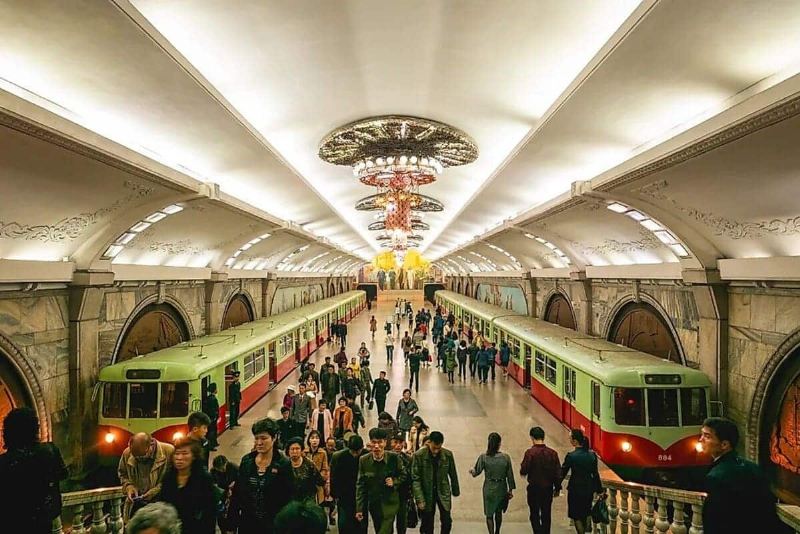
The Pyongyang Metro occupies a special place in the ranking. Here, the average depth of the entire system is taken into account rather than the depth of a specific station.
According to official data from North Korea, the tunnels run more than 110 meters deep. It is difficult to independently verify these figures, but it is known that the metro was originally designed as a shelter system: there are no above-ground sections, and the stations are equipped with hermetically sealed blast doors.
The metro was built from 1969 to 1972 under Kim Il-sung. The temperature here remains around +18°C year-round, and the ascent to the surface by escalator takes about three and a half minutes. The most famous stations, such as Puhung, impress with marble interiors, luxurious chandeliers, and large revolutionary frescoes.
1. Hongyancun — 116 meters
The deepest subway station on Earth is located beneath one of the hills in the Yuzhong District of Chongqing, China.
Hongyancun is situated at a depth of 116 meters — about the height of a forty-story building turned upside down.
The station opened in January 2022 on Line 9, and by the end of 2023, it was complemented by Line 5. It is this station that took the world record from Kyiv's “Arsenal.” Its characteristics are impressive. The height difference between the two main entrances reaches 141 meters. The descent by escalators from the upper entrance takes about eight minutes, and the high-speed elevator moves so quickly that passengers experience ear pressure, similar to that during an airplane descent.
In 2025, Hongyancun received the international Project of the Year award in tunneling. Today, Chongqing even hosts a vertical marathon up the stairs of the station, which has 860 steps. However, most passengers prefer to use the elevator.