How Romans Built Their Impenetrable Camps in Just One Day
After a tiring day march, the Roman legion would stop and immediately get to work. While some soldiers dug a trench, others built an earthen rampart. Within a few hours, a complete fortification would appear around the army. These camps were called castrum by the Romans and were built almost everywhere they stopped.
Many of these temporary camps eventually turned into permanent fortresses and even cities.
The secret to this speed lay in years of preparation and a well-rehearsed system. Military surveyors would mark out the camp according to the same rectangular plan each time. Each unit was assigned its own section of the trench and its own place for tents. Every legionary knew exactly where his cohort would be located and where the commander's tent was.
Throughout the Republic and Empire, the Roman army consistently used fortified camps. While earlier civilizations also protected their encampments, it was the Romans who perfected this process, turning it into a strict system. As early as the 2nd century BC, historian Polybius described Roman camps as structures with a unified standard plan that soldiers could reproduce in almost any terrain. This standardization provided numerous advantages. The camp protected warriors and supplies from sudden night attacks, served as a reliable base for reconnaissance raids, operation preparations, and battle organization. Even in unfamiliar territory, every soldier could easily find his unit, headquarters, supplies, and defensive positions.
The importance of such preparation became especially evident in critical moments. During the Battle of Sabisa in 57 BC, Julius Caesar's troops had just begun to erect the camp when they were unexpectedly attacked by the Nervii and their allies. Some legionaries were still digging the trench, while other units and supplies had not yet fully arrived. Soldiers had to drop their tools, quickly form battle lines, and engage in combat. The camp was not yet ready to serve as a full-fledged fortress, but discipline and clear distribution of duties allowed the Romans to quickly organize a defense and withstand the sudden attack.
Temporary camps also allowed Roman armies to penetrate deep into hostile territories. Instead of relying on existing cities and permanent fortresses, the legion could always create a fortified base in almost any suitable location. Each new camp became a temporary stronghold of Rome.
Layout of a Roman camp
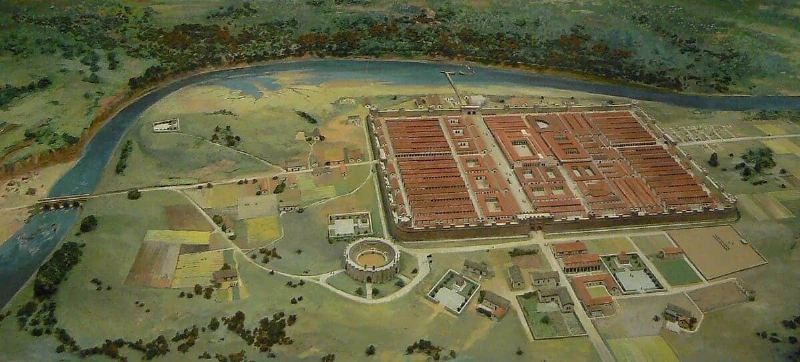
Roman camps typically had a square or rectangular shape with slightly rounded corners, which were easier to defend. Their sizes depended on the number and composition of the troops, but the overall scheme remained virtually unchanged.
In the center was the commander's headquarters. Surrounding it were tents for senior officers, rooms for administration, meetings, religious ceremonies, and storage of supplies. Wide main roads ran through the camp, dividing it into organized sectors. Narrower streets led to the tents of individual legions, cohorts, and auxiliary units.
Leather or canvas tents for soldiers stood in neat rows. This way, no one wasted time looking for a place to sleep or their commander — the location of each unit was known even before construction began.
Read this article in full and everything else in Telegram, ad-free
Open in TelegramThanks, I just want to finish reading here
Between the living rows and the outer fortifications was a free strip called the intervallum. It kept the tents at a safe distance from enemy projectiles, reduced the risk of fire spreading from the edge of the camp, and provided space for troop movements, pack animals, and patrols along the defensive line.
The outer defense usually began with a trench — fossa. The excavated earth and stones were piled along the inner edge of the trench, forming an earthen rampart — vallum. It was reinforced with sod and wooden stakes that soldiers carried with them or prepared on-site.
Most camps had several gates located around the perimeter. They connected to the main roads inside the camp, allowing troops to quickly enter, exit, or form up for departure. In a typical marching camp, the gates could simply be a well-protected passage in the rampart, while long-term fortifications were equipped with massive gates, towers, and additional defensive structures.
Types of Roman camps
Not all camps were built with the same expected duration of stay. Some were intended for just one night, while others were used as winter quarters or permanent military bases.
Seasonal or marching camps were called castra aestiva. They were erected during active campaigns. If the army was set to march the next morning, the fortifications could be relatively simple. However, when close to the enemy, the camp was equipped with deeper trenches and stronger ramparts.
Winter camps — castra hiberna — were designed for long-term stays. Since troops remained here for the entire cold season, these camps received stronger fortifications, improved living quarters, storage facilities, workshops, and stables. Temporary tents were often replaced with wooden structures or reinforced with local building materials.
Permanent camps were called castra stativa. Many of them started as ordinary earthen-wooden fortifications but were later rebuilt into stone fortresses with substantial buildings. Inside such legionary camps could be barracks, baths, hospitals, and other structures.
Civilian settlements gradually arose near permanent military bases. Merchants, soldiers' families, and craftsmen settled near the fortresses, supplying the garrisons with goods and services. Many modern European cities grew around former Roman camps or directly on their sites.
However, the boundaries between different types of camps were not rigid. A temporary camp could turn into a winter one, and a winter camp could eventually become a permanent fortress. Commanders always adapted the standard scheme to the terrain, threat level, and current needs of the army.
How a camp was built
Preparation began even before the main forces arrived. A special detachment would go ahead to choose a suitable location and conduct its layout. Preference was given to solid, well-drained terrain with access to water, roads, and necessary resources. They tried to avoid low-lying areas prone to flooding and spots where the enemy could secretly set an ambush.
After selecting the site, surveyors marked the location of the headquarters, roads, places for units, and the outer defense line. Using flags, measuring tools, and standard distances, they quickly created a camp plan, adapting it to the terrain's features as needed.
When the main army arrived, the work was distributed among the units. If there was an enemy nearby, part of the troops would stand guard while others began construction. In a safe environment, more soldiers were involved in the work.
The first step usually involved digging the defensive trench. The earth and stones were thrown inside, creating the foundation for the future rampart. The size of the fortifications depended on the level of danger. For a peaceful night, a relatively shallow trench was sufficient, while near the enemy, significantly more powerful defensive lines were constructed. The rampart was then reinforced with earth, sod, or wood, gates and additional obstacles were arranged. After completing the outer defense, units would set up tents, distribute supplies, and prepare food.
This system was effective because construction work was performed by almost the entire army. Legionaries were trained not only in combat but also in marching, earthworks, and building fortifications. In the early Empire, a legion typically numbered around five thousand men and was divided into ten cohorts. Most cohorts consisted of six centuries of about 80 warriors, each commanded by a centurion.
Thousands of well-trained soldiers working simultaneously could erect the main fortifications and set up camp much faster than any less organized army. However, ancient sources do not confirm the widespread claim that every Roman camp was invariably built in exactly three hours. The duration of work depended on the terrain, troop numbers, and enemy actions. However, under favorable conditions, due to standard organization and discipline, the army could indeed create a reliably fortified camp in just a few hours.
The significance of Roman camps
The Roman camp provided the army not only with physical protection but also maintained a high level of discipline, training soldiers to act as a unified, well-organized mechanism. It made a strong impression on the enemy: observing how an army, after a long march, surrounds itself with trenches, ramparts, and guarded gates in just a few hours, enemies inevitably understood how organized and prepared their opponent was.
That is why Roman military camps became one of the most important elements of the success of the Roman army. These mobile fortifications allowed for the rapid establishment of a safe base in almost any suitable terrain. Their uniform layout eliminated confusion, powerful defenses deterred attacks, and the construction process vividly demonstrated the discipline and engineering skills that helped Rome wage wars and maintain control over a vast empire.