Greece and Spain Battle Ongoing Wildfires
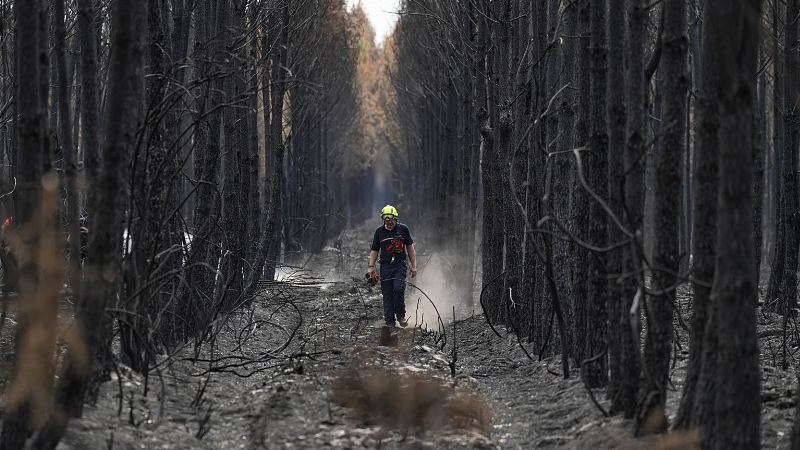
While France has managed to contain wildfires in Bordeaux and the southeast, Greece continues to fight numerous blazes in the capital region and on the island of Cephalonia.
Strong winds have been spreading the flames, significantly increasing the damage. In Spain, new fire outbreaks are occurring in Zamora and Castellón, but most fires have been contained.
Winds Fuel Wildfires in Greece
Greek Prime Minister Kyriakos Mitsotakis stated that the country is facing extreme weather conditions, with wind speeds often reaching 100 km/h.
“This (gale-force wind) creates extremely challenging conditions, making it difficult for planes to scoop water or drop it due to severe turbulence,” said Greece's Minister of Civil Protection Evangelos Tournas.
For another night, ground firefighting units battled the flames near Athens (Attica, Boeotia, and Phocis) under particularly difficult conditions: strong winds persisted, and shortly before midnight, a new fire front emerged on the island of Cephalonia in the Ionian Sea.
The Ministry of Civil Protection reported that although the wind weakened late Saturday evening, on Sunday, the capital region of Athens, neighboring Viotia, and the island of Evia remained at nearly maximum fire risk levels.
Firefighters attempted to prevent the flames from reaching the western outskirts of Athens after the fire spread to the mountain range overnight.
Porto Germeno and other villages were evacuated when the fire broke out on Friday, but local authorities report that dozens of homes have been damaged or destroyed.
Earlier this week, fires on the islands of Crete and Paros affected another 6,000 hectares.
Firefighters face dozens of new outbreaks daily, and as Minister of Civil Protection Evangelos Tournas stated on Saturday, the fire service is “stretched to its limits.”
Read this article in full and everything else in Telegram, ad-free
Open in TelegramThanks, I just want to finish reading here
This week, three firefighters lost their lives while on duty: two on Crete and one in the Peloponnese.
Meteorologist Theodoros Giannaros reported that the fires in the Porto Germeno area have burned over 10,000 hectares, nearly double the initial estimate.
“Unfortunately, it is highly likely (if not almost certain) that this fire will be classified as a megafire,” Giannaros wrote on Facebook.
By Sunday, wildfires in Greece had devastated over 12,000 hectares of forest and agricultural land.
Like the rest of the Mediterranean, Greece is severely affected by the climate crisis: every summer, wildfires ravage the country due to high temperatures, frequent heatwaves, and drought.
Fires in France Contained
Since early July, 63,000 hectares of forest and agricultural land have burned in France. The largest fire in the Gironde department near Bordeaux is now contained; it burned 42,000 hectares and destroyed 240 homes.
“We have returned to a more stable situation there,” said Prime Minister Sébastien Lecornu, confirming earlier statements by Interior Minister Laurent Nunez.
Of the 220,000 people evacuated, 208,000 have been able to return home. This is the largest natural fire in the country since 1949.
The fire in the southeastern Var department remains under close watch. According to regional prefect Simon Babre, firefighters have managed to halt the advance of the fast-moving flames that erupted on Friday.
He noted that the strong winds fanning the flames caused it to spread “faster than a galloping horse,” and warned that the situation remains “extremely unstable.”
“We remain cautious because the fight continues,” he added.
For several weeks, France has been battling wildfires following a series of deadly heatwaves that have dried up riverbeds and vegetation—extreme weather events that scientists link to anthropogenic climate change.
Across the country, police have arrested 308 people on suspicion of involvement in the fires, with 33 remaining in custody.
Fires Rekindle in Spain
Spain continues to battle numerous wildfires after lifting the nationwide state of emergency on Thursday.
In Zamora province in northeastern Spain, the fire in Fermoselle (11,134 hectares burned) reignited in the Mamoles area on Saturday, but it has been brought under control thanks to the deployment of seven helicopters and three planes, and residents have returned home.
The situation is worsening in León province: in addition to outbreaks in Veguellina (where residents of three villages have been evacuated) and Valdelalobe, a new fire has emerged in San Tirso.
In Cáceres province, a truck fire on the A-66 highway sparked a wildfire, leading to the precautionary evacuation of 150 people from Grimaldo and 650 from Casas de Millán.
On Sunday, they were allowed to return home, although they were advised to stay indoors; by that time, about 1,500 hectares had burned.
Major fires in the Sierra Oeste region in the provinces of Madrid and Ávila (covering over 70,000 hectares) remain under control.
Finally, in the eastern region of Castellón, the fire in Val d'Uixó has been stabilized on the seventh day: 9,568 hectares burned, and all evacuated residents have been relocated. The Civil Guard suspects that the fire may have been caused by arson after two separate ignition points were discovered.
From January 1 to August 2, 2026, 186,544 hectares of forest have burned in Spain, according to preliminary data released on Sunday by the Ministry of Ecological Transition and Demographic Challenge.
Across the EU, wildfires have burned approximately 485,000 hectares this year—about half the area of Cyprus.