Fed Unanimously Raises Rates for the First Time Since 2023, Defying Trump
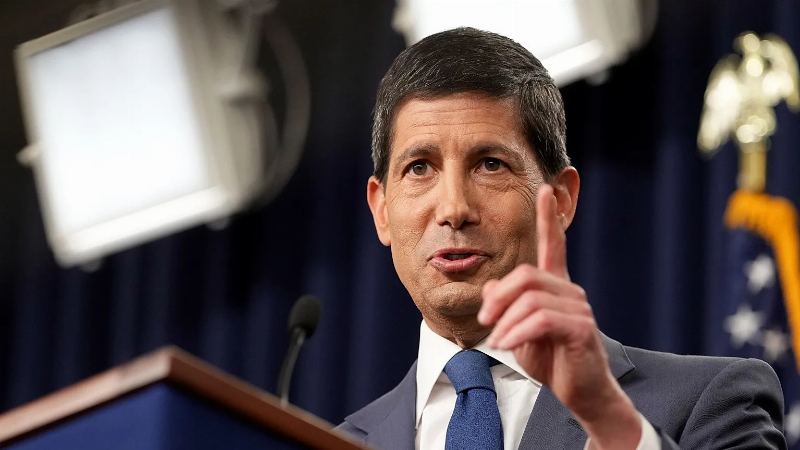
Kevin Warsh, in his first decision as head of the Fed, went against President Donald Trump — and did so with the full support of the entire committee.
On Wednesday, the Federal Open Market Committee raised rates, ending a range of 3.5–3.75% that had been held since December, and concluded a pause that had become increasingly difficult to explain amid rising prices fueled by higher energy costs.
The decision was unanimous: 12 votes in favor, none against.
This is significant because pressure on the Fed came from both sides: in July, three regional bank presidents advocated for a rate hike, while the White House insisted on a cut for several months.
At the time of writing, there was little market reaction to the decision, likely because the rate hike was widely anticipated.
Notably, the way the Fed communicated its decision was just as remarkable.
The statement was condensed into three short paragraphs — a small fraction of the usual length, without any hints at future steps or vague wording.
“Inflation remains elevated,” the document stated, noting that “today’s monetary policy decision will contribute to a more timely return to the Committee’s target level of 2%.”
The phrasing “more timely” essentially acknowledges that the process of returning to the target has been too slow.
Then came a phrase that the Fed almost never uses: “The Committee will ensure price stability.” Not “strives to ensure,” not “is committed to the goal,” but “will ensure.”
The assessment of the economy was also delivered in a confident tone.
According to the Fed, business activity “is growing at a steady pace,” internal spending “shows resilience,” productivity growth is “strong,” investment in fixed assets remains “substantial,” and employment growth “keeps pace with the expansion of the labor force.”
Read this article in full and everything else in Telegram, ad-free
Open in TelegramThanks, I just want to finish reading here
However, the Fed acknowledged that uncertainty remains elevated, partly due to “geopolitical events” — a reference to the war with Iran.
By describing the economy as healthy, the committee effectively dismissed the argument that higher rates could undermine growth — a point that President Donald Trump had insisted on.
The Fed had been moving toward this decision for several months.
In July, three regional bank presidents voted with a special opinion in favor of a rate hike — the largest divergence of opinions in one direction since 2016. After the meeting, several officials stated they were ready to act if inflation did not decline, which it did not.
The personal consumption expenditures index, which the Fed considers the preferred inflation indicator, was 3.7% in June and July, while the core figure was 3.3%. Before the war with Iran triggered a spike in fuel prices, core inflation had been at 3%.
Consumer prices in August remained at 3.4% year-on-year, but their month-on-month increase of 0.4% was the highest since May, indicating the transmission of the energy shock into the economy. Inflation has exceeded the target of 2% for more than five years.
In fact, Warsh had tied himself to commitments back in August at the Jackson Hole symposium, stating that it would be “difficult to characterize overall financial conditions as restrictive” and warning that if core inflation did not start to “clearly and sufficiently quickly” approach the target level, the Fed would have “work to do.”
Markets took his words seriously: according to the CME FedWatch indicator, the probability of a rate hike before today’s meeting exceeded 90%.
Meanwhile, President Donald Trump had been demanding the opposite for months, insisting that the country should have the lowest interest rates in the world, and largely chose Warsh, hoping he would deliver that.
Today’s decision may also help restore the Fed's reputation as an independent institution.
Technical parameters indicate that the Fed is solidifying at the new rate levels.
Starting Thursday, the interest on reserve balances will rise to 3.90%, the primary credit rate will increase to 4%, and permanent repo operations will also be conducted at 4%. Seven regional reserve banks requested an increase in the discount rate.
According to the updated Fed's “dot plot,” 12 out of 18 officials expect another increase of 0.25 percentage points by the end of the year, which would raise the rate to 4.125%, while four predict an increase to 4.375%.
A strong signal extends far beyond 2026: 14 members of the leadership believe that by the end of 2027, the rate will be higher than the current level, and the median forecast for 2028 is 3.9% compared to the previously expected 3.4%.
The assessment of the long-term equilibrium rate has also risen — to 3.2%, indicating that more officials are convinced that the neutral level of interest rates has increased, and economists expect further revisions of these estimates.