OpenAI Unveils Major AI Breakthroughs and Collaboration with Scientists
On October 26, OpenAI announced three significant results achieved by its models. In mathematics, it is the proof of the local smoothing hypothesis; in theoretical computer science, the refutation of the exponential time hypothesis; and in physics, a rigorous proof of the existence of quantum chromodynamics. For the first time, the company not only published the proofs but also submitted them for review by independent groups of scientists.
The most notable result concerns theoretical computer science: AI has refuted the exponential time hypothesis (ETH). Formulated in 1999 by Russell Impagliazzo, Ramamohan Paturi, and Frances Yao, it is related to the central open problem in computer science — the question of the equality of classes P and NP. Class P includes problems that can be solved quickly by a computer, while NP includes problems where a solution can be verified quickly. For example, sudoku: checking a filled grid is easy, but filling it can be very hard. Most scientists believe that P ≠ NP, meaning that finding a solution is fundamentally harder than verifying it. This underpins cryptography: with a known key, a cipher can be read instantly, while finding the key could take years.
ETH clarifies this intuition. It asserts that the 3-SAT problem — the satisfiability of a logical formula — cannot be solved faster than exponentially growing time with respect to the number of variables in the worst case. Therefore, ETH has been considered a strong argument in favor of P ≠ NP. Hundreds of works rely on it to assess the conditional difficulty of problems — from graph theory to computational biology.
If classes P and NP are equal, it would mean there exists an algorithm that finds solutions as easily as they can be verified — which would spell the end of modern cryptography. However, scientists emphasize that the refutation of ETH does not imply the equality of P and NP.
The mathematical result pertains to harmonic analysis. In 1991, Sogge conjectured that the limiting focus of waves is always short-lived: at a typical moment, it is much weaker than at its worst. In 2019, Gut, Wang, and Zhang proved this local smoothing hypothesis for two dimensions, and in 2025, Wang and Zal proved the hypothesis in three dimensions. The model demonstrated local smoothing in all dimensions using a new auxiliary equation in partial derivatives.
Read this article in full and everything else in Telegram, ad-free
Open in TelegramThanks, I just want to finish reading here
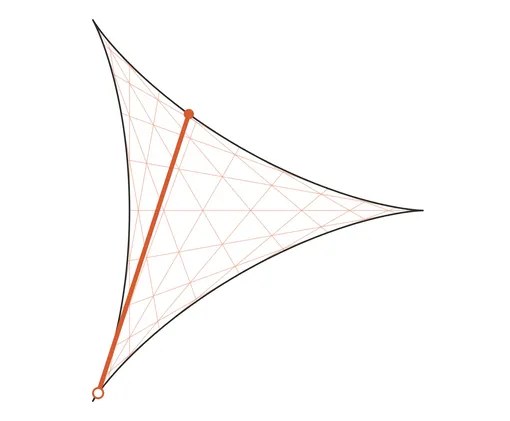
The Kakeya needle problem. A unit-length segment can be rotated 180 degrees inside a deltoid — a curve with three vertices and an area of π/8. The ends of the segment slide along the boundary, while it continuously touches it (the pale lines represent intermediate positions of the needle). In 1928, Abram Bezikovich showed that the area of the figure in which the needle can be rotated can be made arbitrarily small. However, according to the Kakeya conjecture, a set containing a segment of any direction remains “full-dimensional”: in n-dimensional space, its dimension equals n. This conjecture follows from the local smoothing hypothesis of waves, which, according to OpenAI, the model has proven in all dimensions.
The consequence of this result was the proof of the Kakeya conjecture for any dimensions. This conjecture was formulated a hundred years ago. The Fields Medal in 2026 was awarded to Hong Wang for proving the Kakeya conjecture in three dimensions. AI actively utilized the result obtained by Hong Wang and her colleagues, but it is unclear whether she would have received the Fields Medal if the result obtained by AI had already been known.
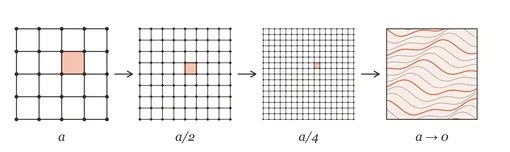
How quantum field theory is constructed. To give meaning to Yang-Mills theory, spacetime is replaced by a lattice. The field is defined on its edges, and interactions occur on elementary cells, or “plaquettes” (colored). This lattice theory, proposed by Kenneth Wilson in 1974, is strictly defined, but it is only an approximation. The true theory is the limit as the lattice spacing approaches zero, just as the integral is the limit of Riemann sums. For half a century, physicists have been working on lattices, but no one has been able to prove that this limit exists in the four-dimensional case. OpenAI claims that its model, building on Tadeusz Balaban's approach, has proven the existence of such a limit for quantum chromodynamics and pure Yang-Mills theory. The second half of the millennium prize problem — the existence of a mass gap — remains open.
In physics, a rigorous proof of the existence of quantum chromodynamics and the simplest grand unification theory, including the Standard Model, has been obtained. Additionally, the existence of pure Yang-Mills theory has been proven — this is part of one of the millennium prize problems. The proofs emerged back in September, but due to their volume, formal verification in the Lean system was awaited.
Who will verify the machine
The AI manuscripts are referred to by the company as “raw data” that still need to be transformed into understanding. Each discipline has its own order. The mathematical result was immediately posted on GitHub at the advice of an expert. Computational complexity specialists led by Ryan Williams from MIT, Impagliazzo, and Paturi formed a working group, reached out to colleagues with an open letter, and secured funding from OpenAI for a conference: many papers relying on ETH will need to be revisited. A group led by Nobel laureate David Gross, which includes Arthur Jaffe and Nikita Nekrasov, has decided not to publish the AI materials for now and to write a summary themselves.
Participation of scientists is voluntary and unpaid, without non-disclosure agreements. OpenAI does not claim authorship of the discoveries, and recognition should go to those who explain them. The company acknowledges that the choice of those who will work with AI solutions creates inequality in access to information.
Williams previously referred to the flow of proofs from OpenAI as a DDoS attack on mathematicians, but agreed to help. According to him, part of the proof is routine, but two or three fragments look “alien” — the entire community should work on them. His first question was whether the algorithm breaks cryptosystems — OpenAI found no threats. In Williams' opinion, P = NP now looks more plausible, although the OpenAI algorithm is unlikely to be final. AI, he says, forces scientists to set more ambitious tasks: what they were working on before has become easy prey for the machine.