Cable Bacteria: How Living Organisms Create Electric Wires
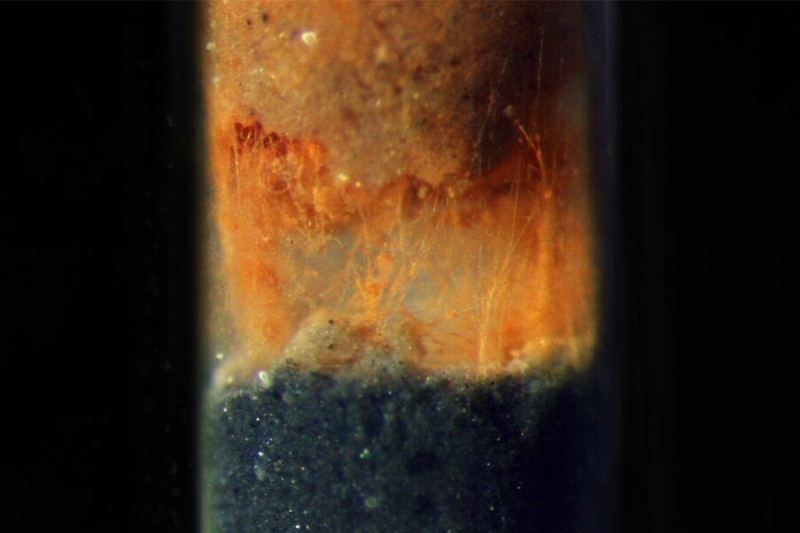
Cable bacteria live in sediment worldwide, pulling electric wires through mud that can be several centimeters long, feeding on electric current. Researchers from the University of Antwerp have discovered how these wires are structured: they are made of intertwined nanostrips of nickel and sulfur-containing organic material. This is the first known metal-organic framework created by a living organism.
Cable bacteria are not the only natural “electricians.” The bacterium Geobacter sulfurreducens grows protein nanowires to transfer electrons to iron minerals. Derek Lovley from the University of Massachusetts Amherst studies it. In 2020, his team showed that a thin film of such nanowires generates electricity directly from moisture in the air. This bacterial device produced about 0.5 volts continuously for many hours.
Cable bacteria were first discovered in 2009 by a group led by Lars Peter Nielsen from Aarhus University in the Danish harbor. Since then, they have been found in sediment of lakes, rivers, and seas worldwide. They feed on hydrogen sulfide released during the decay of organic matter. The bacteria extract electrons from it and ultimately transfer them to oxygen, taking the energy difference for themselves.
Read this article in full and everything else in Telegram, ad-free
Open in TelegramThanks, I just want to finish reading here
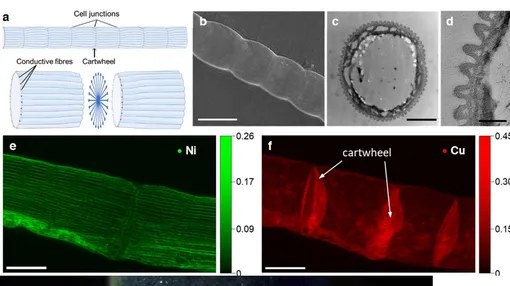
Microscopic visualization and nXRF mapping of periplasmic filaments in cable bacteria.
The challenge is that there is plenty of hydrogen sulfide deep down, while oxygen is only available in the thin upper layer of sediment. The bacteria have solved this problem. When dividing, the cells align into a thread with a shared outer membrane, forming a single superorganism, a kind of electric respiratory tube. The lower cells oxidize hydrogen sulfide, while the upper ones release electrons to oxygen, and the current flows through the thread. Wires up to 5 centimeters long have been found, containing up to 25,000 cells. There can be about 20,000 kilometers of such threads in a square meter of sediment, and the bacteria significantly alter the chemistry of the sediment. The work is published on the preprint site biorxiv.org.
Nickel Braid
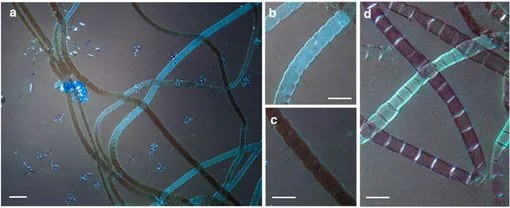
For over ten years, it remained unclear what the wires themselves are made of. Philip Meisner's team examined the threads under an electron microscope. Dozens of ridges run along the perimeter of each thread, and each contains a conductive fiber about 50 nanometers thick. Inside the fiber, 10 to 20 nanostrips, each only about 1.35 nanometers wide, are intertwined.
X-ray spectroscopy and computer modeling showed that the bacteria extract trace amounts of nickel from water and sediment. They bind nickel atoms with sulfur-containing organic molecules into flat plates. The plates stack in several layers to form nanostrips, which are then woven into bundles like copper wires in household cables.
The authors believe they have created the first known metal-organic framework structure of biological origin. They estimate that a single nanostrip conducts electricity about a hundred times better than synthetic nickel counterparts. The work is currently a preprint and has not yet been peer-reviewed, but Nielsen calls the result very impressive. This structure could provide insights into how to grow flexible biocompatible electronics with minimal metal and energy consumption.