Remarkable Discovery: Soft Dinosaur Eggs Found in China
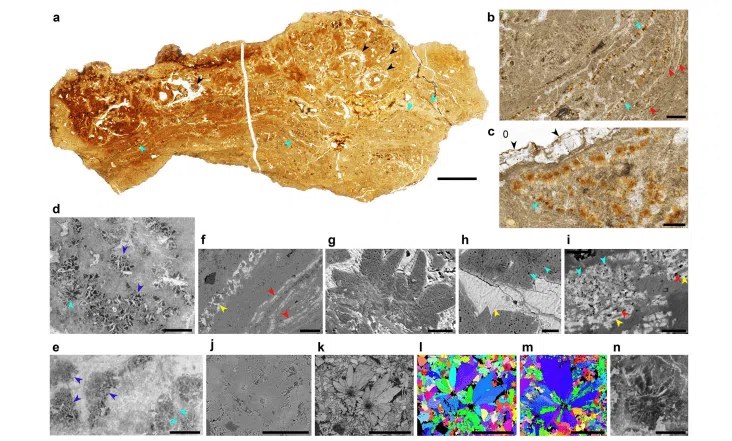
The soft shell may represent an important stage in the evolution of dinosaur eggs, but fossils rarely preserve its original structure. A new find from China, dating back to the Early Jurassic period, has allowed researchers to examine not only the shell but also the organic matrix.
Soft dinosaur eggs have previously caught the attention of paleontologists: in 2020, a study published in Nature described signs of nearly unmineralized shells in the eggs of Protoceratops and Mussaurus. Researchers suggested that early dinosaurs might have laid soft eggs, while hard shells evolved independently later in different evolutionary lines.
Now, scientists from Hebei University and the Chinese Academy of Sciences have described another soft shell of ancient reptiles — this time partially mineralized. The fossil was discovered in Early Jurassic deposits in Yunnan province, China. The article was published in Nature Communications.
Read this article in full and everything else in Telegram, ad-free
Open in TelegramThanks, I just want to finish reading here
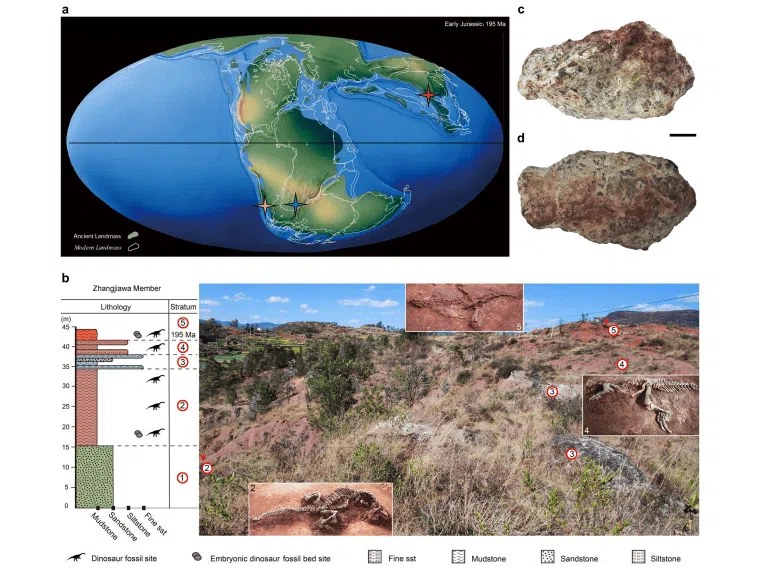
The specimen has been named Mutabilisoolithus dawaensis. It is believed that the eggs belonged to basal sauropodomorphs — early representatives of the dinosaur group that later included long-necked giants like Diplodocus and Brachiosaurus. The find comes from a layer of the Lufeng geological formation, located below where the shell of Lufengosaurus was previously discovered.
The exact age of the specimen has not been determined, but it is attributed to the Sinemurian stage of the Early Jurassic — 190-199 million years ago. In one rock, remains of two embryos and two fragments of shell were found, located between the skeletons.
The main feature of the find is the combination of soft structure with partial mineralization. The shell consisted of a thin layer of limestone and a thicker organic membrane. In the new specimen, the mineral layer made up no more than 41 percent of the total thickness of the shell, excluding the outer cuticle — this is one of the signs of a soft shell.
The Chinese find confirms that soft but partially mineralized eggs existed as early as the Early Jurassic. The authors of the study suggested that this structure represents an early stage of shell mineralization — an intermediate state between a completely organic shell and a more robust, mineral-rich shell.