Scientists Propose Space Umbrella Plan to Shield Earth from Sunlight
The Planetary Sunshade Institute has published an analysis on how to shield Earth from sunlight. Engineers and climatologists, including those from the University of Nottingham and NASA, participated in the study. Construction of the sunshade could begin in 20–40 years.
In 2006, astronomer Roger Angel proposed launching 16 trillion transparent disks, each about 60 cm in diameter, to point L1. They were to be launched using electromagnetic guns. The total mass of the swarm would be around 20 million tons, costing several trillion dollars. The idea of a sunshade at the Lagrange point remains relevant.
Elon Musk mentioned that Earth could be cooled using satellites that shade it from the Sun. Scientists are indeed exploring such ideas.
Read this article in full and everything else in Telegram, ad-free
Open in TelegramThanks, I just want to finish reading here
The new report was prepared with a grant from the British agency ARIA for £400,000. The timeline for the project depends on the emergence of super-heavy rockets capable of delivering millions of tons of cargo into space.
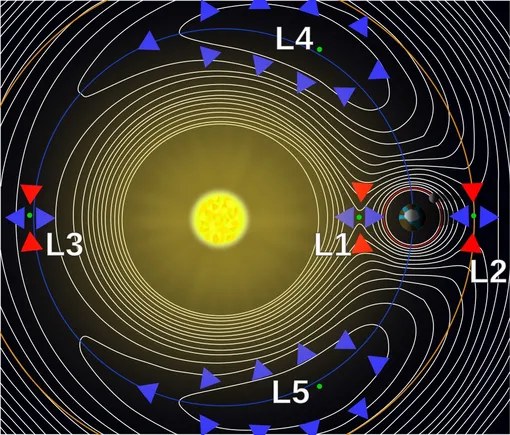
Point L1 between Earth and the Sun is ideal for the sunshade.
Engineer Chantal Cappelletti believes that decreasing launch costs make the project more realistic. Climatologist Daniele Visioni has changed his mind about space options, although he does not expect their realization before the end of the century. Critics remind that thousands of launches would pollute the atmosphere and that discussions about shading distract from the main issue — reducing greenhouse gas emissions.
Between Earth and the Sun
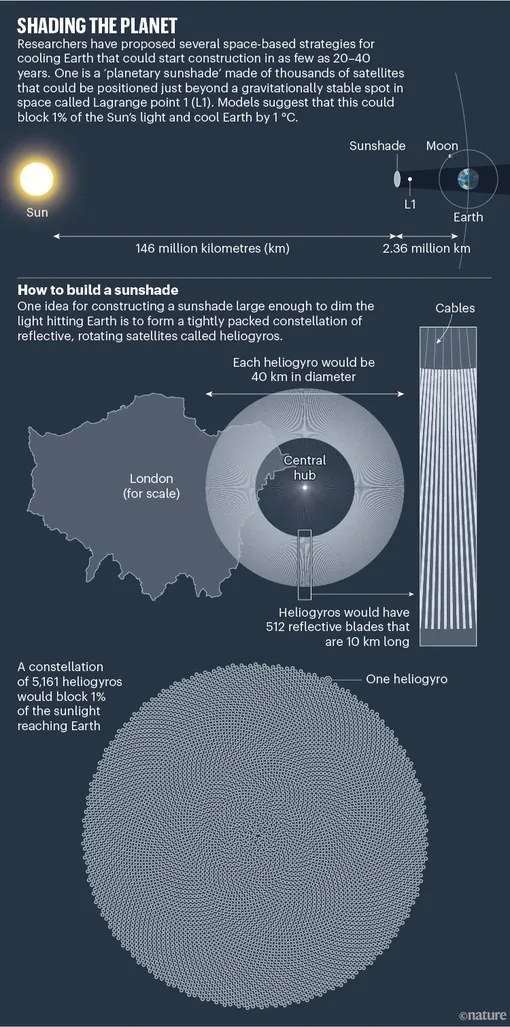
The authors considered six options for a screen that blocks about 1% of solar radiation, which would cool the planet by about 1 °C. The most advantageous location would be just over two million kilometers from Earth, near the Lagrange point L1. The main option is to build 5,000 heliogires, rotating satellites 40 km in diameter. The mass of the structure would be nearly 70 million tons, so some materials are proposed to be sourced from the Moon.
An alternative is a cloud of reflective dust held by electric fields from "shepherd" devices. It is hundreds of times lighter but even more complex to implement. The cost of the screen could reach tens of trillions of dollars, and no single country could handle such a task.