Unique Cabinet with Women's Items and Children's Amulets Discovered in Pompeii
Archaeologists have reconstructed the contents of a cabinet found in the House of Cornelius Maximus in Pompeii. Inside, numerous personal items provide insight into the daily life of its owner.
During excavations, staff from the Pompeii Archaeological Park discovered remnants of a traditional Roman armoire containing jewelry, toiletries, kitchenware, and a small collection of coins. Although the wooden furniture did not fully survive, its original appearance and contents were restored based on archaeological data.
This discovery offers a unique opportunity to study the daily life and material culture of the city before the eruption of Vesuvius in 79 AD, archaeologists noted in an article published in E-Journal degli Scavi di Pompei.
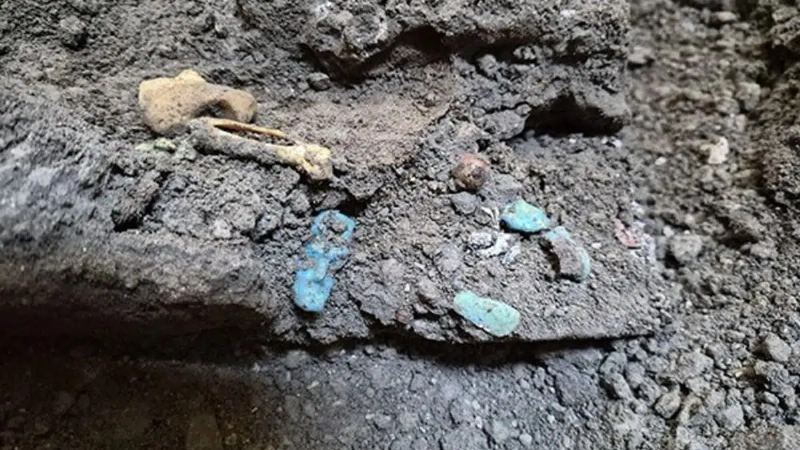
One of the most remarkable finds was a collection of at least 24 miniature items with holes for hanging, which were once part of a necklace. These tiny pendants, made of faience, bone, glass paste, and rock crystal, depicted recognizable figures and symbols: the gods Bes and Mercury, human hands and feet, pine cones, and bunches of grapes.
Archaeologists classified such items as crepundia — a term derived from the Latin verb crepare (to rattle). These small ornaments were traditionally associated with childhood in Ancient Rome. They could serve a dual purpose: as protective amulets and as a type of rattle, making sounds that helped adults keep track of small children.
Read this article in full and everything else in Telegram, ad-free
Open in TelegramThanks, I just want to finish reading here
Many Romans kept their crepundia for life, storing them in boxes or fabric pouches. In this case, the necklace lay in a decayed pouch inside the cabinet. In Roman society, people often moved away from their parents and hometowns, so a child's amulet could be one of the few reminders of home.
Among other finds were items from a women's toiletry set: tweezers, a pestle for grinding cosmetics (coticula), a glass vessel for perfumes or ointments, an incense burner, and a bronze oil lamp. Next to the bronze lamp were lead weights, indicating that some trade may have occurred in the house. The weights were stored in a small wooden box that had almost completely decayed.
On the shelves of the cabinet were also bronze, glass, and ceramic vessels, various kitchenware, and a small elegant jug decorated with a relief pattern resembling pine cone scales.
Additionally, the cabinet contained 38 bronze coins lying in a small woven basket called a cistella. Researchers were even able to study the plant remains from which this basket was woven. The left coins indicate that the owner(s) had no opportunity to take anything valuable with them — whether money or keepsakes, researchers noted.
The cabinet was found in a house traditionally called the House of Cornelius Maximus. This name originated from inscriptions discovered during the excavation of the building's facade in 1912. The house stood on Via dell'Abbondanza — one of the busiest streets in Pompeii. The rooms located deep within the house were explored for the first time.
Given its location and interior decor, it was a fairly comfortable urban residence. In the room where the cabinet stood, exquisite wall paintings remained, indicating a high standard of living for the owners. However, at the time of the eruption, the building was undergoing renovations, making it less convenient to live in, scientists noted.
In addition to the cabinet, another interesting find was made. In an amphora located in one of the upper rooms, 117 tiny bone fragments belonging to at least two young field mice were discovered.