World's First Touchscreen Fabric Integrated into Clothing
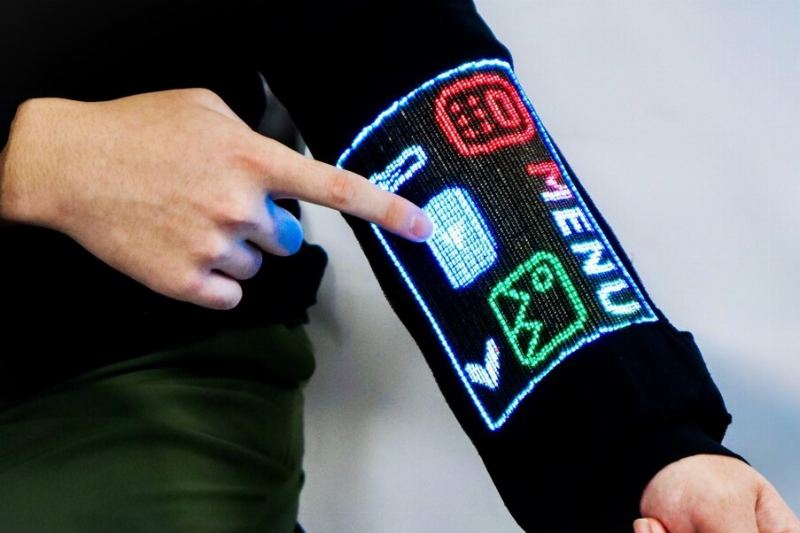
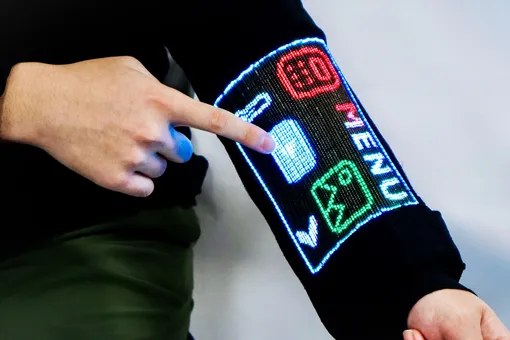
Engineers at the National University of Singapore (NUS) have woven 54 fibers into a clothing sleeve, each serving as a pixel row and touch sensor. This is the world's first touchscreen integrated into clothing: it displays images and videos, responds to finger taps, and connects wirelessly to other devices. The sleeve remains flexible, breathable, and washable.
The sleeve as an interface. Google and Levi’s attempted a similar solution. In 2017, the Commuter Trucker denim jacket was released, featuring conductive threads woven into the cuff. Users could switch music and decline calls by swiping and tapping the sleeve. However, the jacket lacked a screen: the fabric served only as a touch panel, while all electronics were hidden in a removable block on the cuff.
Familiar screens on phones and laptops are flat, rigid panels. Fabric is different: it is woven from one-dimensional threads, and a full-color touchscreen that can be woven like yarn has remained elusive. “The fiber has one-dimensional axisymmetric geometry, making it very difficult to build complex circuits using methods designed for conventional two-dimensional electronics,” explains Tural Khudiev, the project leader from NUS.
Read this article in full and everything else in Telegram, ad-free
Open in TelegramThanks, I just want to finish reading here
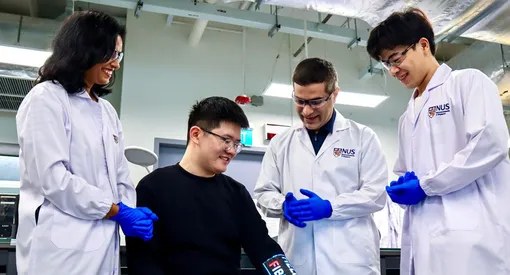
Assistant Professor Tural Khudiev (second from the right) from NUS, along with his team, created the world's first touchscreen integrated into clothing. The flexible sleeve can display images and videos, respond to touches, and connect wirelessly to digital devices.
To overcome this limitation, the team developed a programmable method for creating connection points along the thinnest insulated wires. A laser opens the insulation at the required points, and controlled wetting directs the molten solder to bond only at specified locations.
This allowed them to connect over 5,000 chips through 20,000 electrical connections. Then, a strip of connected LEDs was embedded into a multilayer fiber that is one millimeter thick and ten meters long. Beneath the LEDs lies a touch-sensitive layer: pressing on the thread closes the circuit, signaling where the finger touched, and the nearest pixel lights up.
Screen on the Forearm
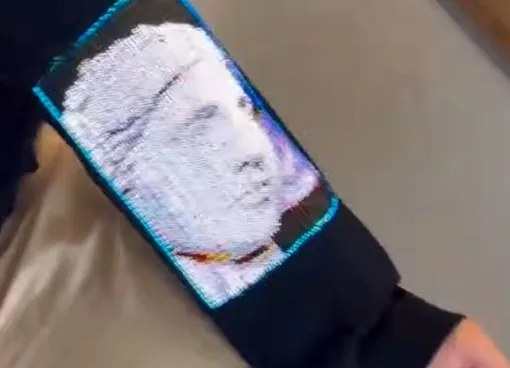
In the prototype, 54 fibers with 96 LEDs each are woven into the sleeve, resulting in a display of 96 by 54 pixels, measuring 168 by 105 mm. It refreshes 30 times per second with 8-bit color depth. Each fiber has its own control channel, so the failure of one thread does not affect the others, and the system can distinguish multiple touches simultaneously. Nearby peripheral fibers are woven using the same method, containing a microphone, speaker, motion sensors, temperature and light sensors, and a magnetic compass.
According to Khudiev, the key to success was the ability to assemble a graphical interface from electronic blocks in the form of fibers. The authors believe that such clothing could serve as a direct interface to the owner's health data and digital devices—without a single rigid screen.
The layer beneath the LEDs responds to touch and lights up the nearest pixel when the fiber is pressed.
This work may have other applications, although the authors do not mention it in the press release. Developers of electronic skin for robots and prosthetics face challenges with wiring: the denser the sensors are placed, the more wires are needed, and the wiring can take up more space than the sensors themselves. In the Singapore fiber, thousands of chips are housed on the thinnest common wires inside a thread that is one millimeter thick. Thus, the technology may also be useful for artificial skin.