MIT Scientists Unveil the Secret of Friendship: One Reliable Friend is Enough
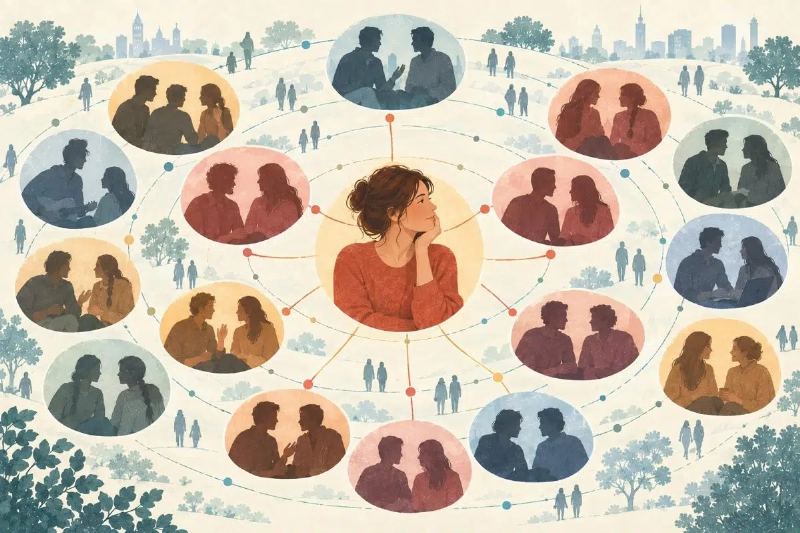
Scientists from the Moscow Institute of Physics and Technology (MIPT) have developed a mathematical model that describes how stable social connections are formed. The researchers discovered a paradoxical principle: non-altruistic behavior of others contributes to multiple close connections.
Cooperative behavior is a cornerstone of social interactions. However, if people always helped each other, they would arrive at a different distribution of social ties.
“Our model shows that if everyone always helps, a person only needs to maintain one close connection,” said Ivan Kozitsin, a professor at MIPT.
In the 1990s, British anthropologist Robin Dunbar formulated a theory suggesting that each person can maintain regular contact with a limited number of people. He studied the correlation between brain size and social group size in primates and concluded that each species has a limit on the number of social ties, determined by physiological factors.
Read this article in full and everything else in Telegram, ad-free
Open in TelegramThanks, I just want to finish reading here
Dunbar determined that the number of social contacts a person can maintain is approximately 150. The circle of closest friends is usually limited to five contacts, acquaintances to 15, good friends to 50, and those with whom we regularly interact to 150. Each subsequent group is roughly three times larger than the previous one. This distribution of social ties is depicted as concentric circles, known as “Dunbar's circles.”
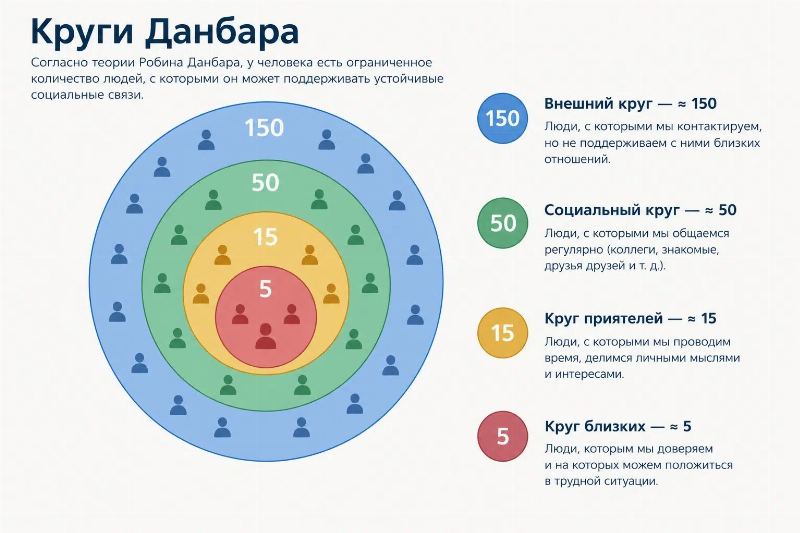
The ego-network model is used to study social groups and is applied in creating algorithms on media platforms. “ENM is useful, but it does not explain why such a structure forms and remains stable,” added Alexander Gubanova, assistant professor at MIPT.
In the early 2010s, a new direction emerged that studies the mechanisms of social network formation. MIPT scientists conducted research in this area.
The model they created is based on interactions between an individual and their acquaintances, where ties are strengthened or weakened depending on assistance. The model includes parameters such as the number of acquaintances, problem complexity, and the probability of refusal to help.
An unexpected result of the model is that with a zero probability of refusal, the agent always chooses the same acquaintance. This paradox became the title of their article: “If all friends are completely reliable, one friend is enough.” Non-altruistic behavior serves as a guarantee of the diversity of our social contacts.
“Our main result has theoretical value. We analytically showed that the probability of refusal is a sufficient condition for the formation of Dunbar's circles,” emphasized Kozitsin.
The article is published in the journal Social Networks.