Hubble Space Telescope Captures Giant 'Cat's Tail' Around Beta Pictoris
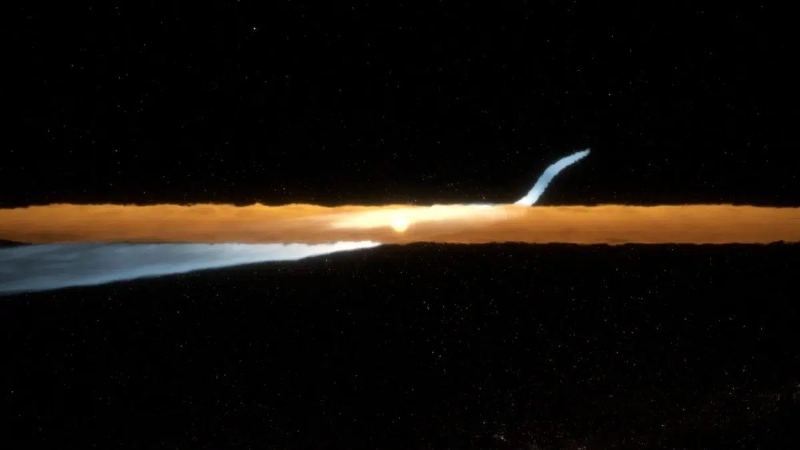
The dust structure known as the 'Cat's Tail' around the young star Beta Pictoris has been captured in visible and near-infrared wavelengths for the first time. New data has provided insights into the past of this planetary system, revealing traces of a cosmic catastrophe — the collision of two sizable celestial bodies.
Beta Pictoris is a young star located approximately 64 light-years from Earth, with an age of about 18.5 million years. It is surrounded by a vast disk of dust and debris from celestial bodies that remain after the formation of the planetary system. Ongoing collisions of asteroids and other bodies allow astronomers to study processes that occurred in the early stages of the Solar System's development.
Massive exoplanets have already been found around Beta Pictoris, whose gravity influences the surrounding disk. However, one of the most unusual features is the 'Cat's Tail' — an elongated curved structure first observed by the James Webb Space Telescope in 2024. It is believed to have formed as a result of a collision between two large celestial bodies approximately 100-200 years ago.
Read this article in full and everything else in Telegram, ad-free
Open in TelegramThanks, I just want to finish reading here
A team of astronomers led by Arin Avsar from the University of Arizona studied this structure using the Hubble Space Telescope. They combined data from six series of observations conducted from 2012 to 2025, resulting in a detailed image of the dust disk at distances of up to 0.008 light-years from the star.
After processing the images, scientists identified a faint glow of the 'Cat's Tail' in visible and near-infrared wavelengths. Its shape matched the image obtained by Webb, although the farthest curved part of the structure remained invisible. Hubble traced the tail approximately 0.0036 light-years from the star.
It was found that in reflected light, the tail is extremely dim. Its radiation flux is only 0.1-0.4 percent of the flux recorded by Webb at a wavelength of 15.5 micrometers. By comparing these measurements, astronomers concluded that the dust particles have high porosity: 55 to 93 percent of their volume consists of voids. Additionally, 85 to 99 percent of the solid material of the particles consists of complex carbon-containing materials that are heat-resistant, while the proportion of silicates is minimal.
Scientists also assessed the scale of the presumed catastrophe. According to calculations, to produce such a quantity of organic dust, two large celestial bodies with radii of approximately 600-800 kilometers could have collided. These objects can be compared to dwarf planets and large moons in the outer Solar System.
New images also showed that the dust halo surrounding the star is noticeably distorted and asymmetrical. Its shape may be altered by the gravitational influence of the planets around Beta Pictoris. However, further calculations will be needed to verify this hypothesis.
Thus, Hubble's observations confirmed the existence of the 'Cat's Tail' in reflected light and provided a better understanding of its origin. According to the authors of the scientific paper published in The Astrophysical Journal Letters, the unusual structure may be a remnant of a relatively recent large-scale collision within the system.