Four Years After Mahsa Amini's Death: Repression Continues in Iran
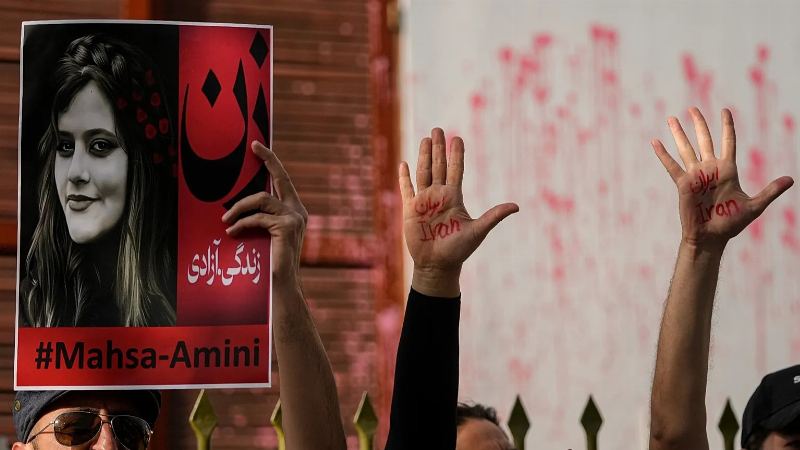
Four years after Mahsa Amini's death in police custody, Kurdish businesses across her home region staged a general strike on Wednesday. International human rights organizations warn that those responsible for suppressing the protests of 2022 remain in power and continue to use the same tactics.
Shop and business owners in Saqqez, Sanandaj, Mahabad, Marivan, Baneh, and Bokan closed their doors following a call from Kurdish political coalitions. Videos shared on social media showed empty bazaars throughout the region.
In a report by Amnesty International, it is stated that those who led the brutal suppression of the 2022 protests still control Iran's security apparatus.
European Parliament President Roberta Metsola stated that the parliament will continue to support young Iranians facing execution or imprisonment, particularly highlighting the case of twin sisters Taraneh and Romina Rahimi, sentenced by the Revolutionary Court of Tehran after recent protests.
“The European Parliament will keep their light until it breaks through the darkness,” Metsola said.
UN Special Rapporteur on Human Rights in Iran, Maya Sato, noted that four years of brutal state violence, including the use of lethal force during nationwide protests in late 2025 and early 2026, have not been able to break the resistance.
“Four years later, the resistance sparked by the death of Gina Mahsa Amini has not been suppressed,” Sato stated.
“Women and girls who took to the streets in her memory continue to insist on their right to decide what to wear, where to work, and how to live… These rights cannot remain contested forever.”
Read this article in full and everything else in Telegram, ad-free
Open in TelegramThanks, I just want to finish reading here
Sato also noted that despite the formal suspension of the law “On Family Protection through Promoting the Culture of Modesty and Hijab” since December 2024, cafes, restaurants, and shops continue to be closed for violating hijab rules, with reports of arrests in some cases.
What Happened to Mahsa Amini?
22-year-old Amini was detained by Tehran's “morality police” on September 13, 2022, for allegedly violating mandatory hijab rules and died three days later after brutal beatings in custody.
An independent international fact-finding mission by the UN concluded that she was subjected to physical violence in custody and that Iranian authorities are responsible for her death. Iranian officials rejected the mission's findings.
In the days following her death, protests erupted across the country. While centered on mandatory hijab and women's rights, the movement united demands for political freedoms, minority rights, economic justice, and changes to the political system.
The UN fact-finding mission recorded up to 551 fatalities in 26 provinces, including at least 49 women and 68 children, stating that some violations reached the threshold of crimes against humanity.
According to Amnesty International, Tehran authorities acknowledged the detention of over 22,000 individuals; the organization also documented cases of enforced disappearances, unfair trials, and death sentences.
Tehran's Focus on High Technology
The hijab law remains in effect, the political structure has not changed, and many protest participants are imprisoned or sentenced.
The regime is shifting its focus from “morality police” patrols to surveillance cameras, facial recognition technology, drones, and digital tools. Iranian police announced in 2023 that street cameras would be used to identify women without hijabs.
The 2025 report by the UN fact-finding mission states that facial recognition systems are used to monitor students' clothing at Amir Kabir University of Technology in Tehran.
A 2025 study published in the journal Iranian Studies described the women's rights movement as having sparked a “cultural revolution” alongside a political one, asserting that it has weakened the state's ideological control over public and cultural life.
Footage of “morality police” vans detaining women on the streets became one of the strongest symbols of the 2022 protests and prompted authorities in Tehran to avoid open confrontation in public.
The growing presence of women without headscarves in public spaces and the central role of women's rights and freedoms in political discussions indicate that the situation has not returned to its pre-September 2022 state, a direct consequence of this movement.